
Saco Oliveros de Lince Takes Gold as San José Closes with Emotion and a Tribute to Mothers
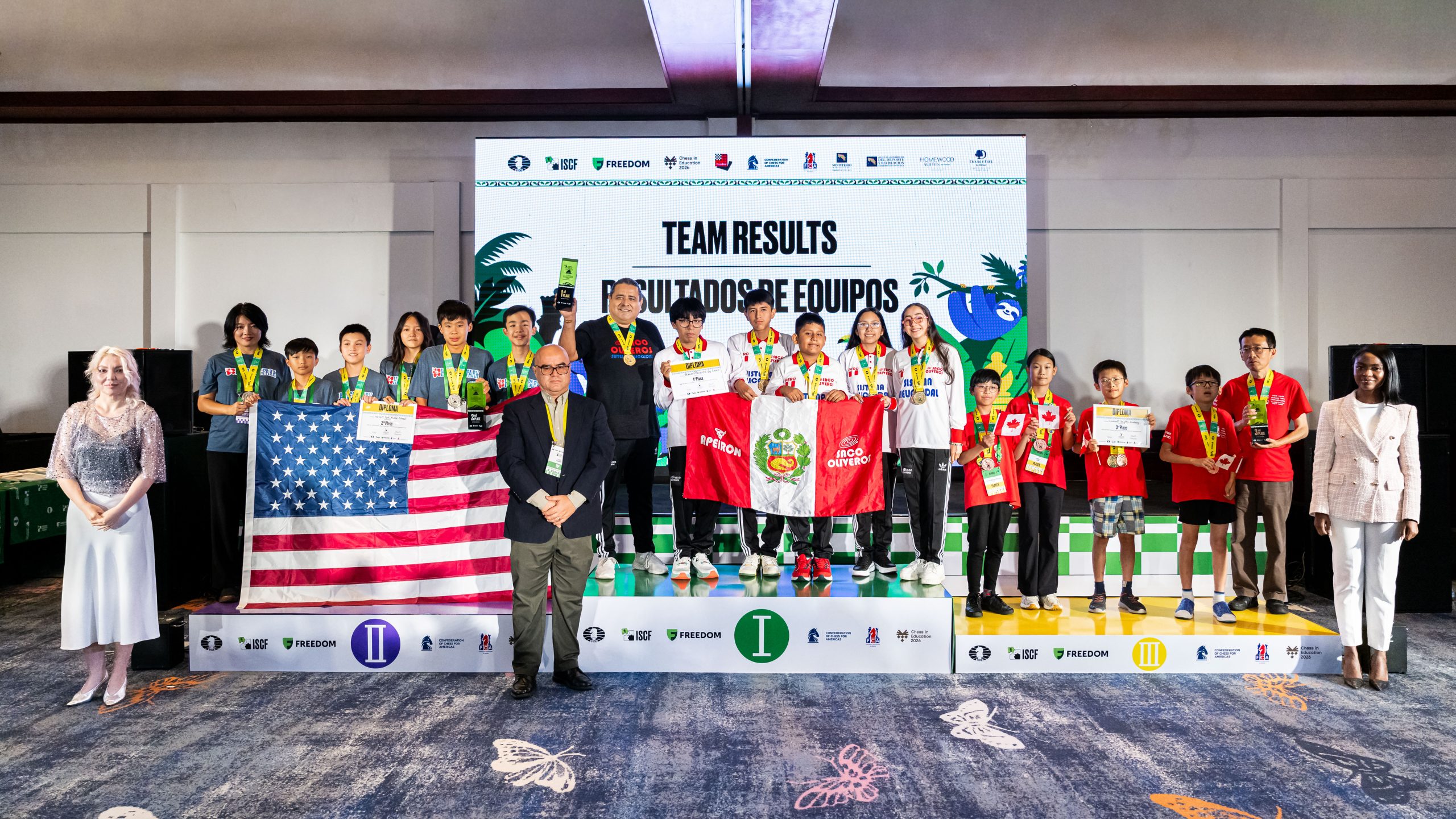
The American Continental Stage of the FIDE ISCF World Schools Team Championship 2026 closed at the DoubleTree by Hilton Cariari in San José with the team that led it home from Wednesday still in front. Saco Oliveros de Lince of Peru won the title without losing a match all week, finishing on 15 match points from a possible 16. Harvest Park Middle School of the United States took second and Crescent Heights Academy of Canada third, and all three now go through to the Grand Final in December. Round 7 Saco Oliveros began the final day the way they had ended the previous one. Having beaten both of their nearest rivals on Thursday, they opened with a 4-0 sweep of Chile’s Saint Gabriel’s School, and from that point the title was theirs to lose. The tension was further down the hall, where the teams behind them were playing for the two remaining qualifying places. Colegio Madre del Divino Pastor 1½-2½ Harvest Park Middle School The American Continental Stage of the FIDE ISCF World Schools Team Championship 2026 closed at the DoubleTree by Hilton Cariari in San José with the team that led it home from Wednesday still in front. Saco Oliveros de Lince of Peru won the title without losing a match all week, finishing on 15 match points from a possible 16. Harvest Park Middle School of the United States took second and Crescent Heights Academy of Canada third, and all three now go through to the Grand Final in December. Board one brought two closely rated titled players together, FM Lucas Mason Pin Qian Yao against CM Fernando Cortes Medina, and produced no fireworks at all: a balanced game and a peaceful draw. The fireworks were on board two, where Colegio Celta Internacional’s Sophia Itzayana Mote Amasifuen (pictured above), with White, launched a kingside attack and finished it with a sacrifice. Position of the round 2qbrr2/pp1b1pkp/1np3p1/3pPpNP/3P1B2/2P4R/PP2QPPN/4R1K1 w – – 3 24 White played 24.Nxh7!, drawing the black king onto the h-file, because after 24…Kxh7 25.hxg6+ there is no defence. The game finished 25…Kg8 26.Qh5 fxg6 27.Qh7#. On boards three and four, Aiden Yin and CM Andrew Yin both outplayed their opponents comfortably and took the match for Canada. Round 8 Saco Oliveros de Lince 4-0 Martin Klein Schiller The champions finished as they had started the day, with another clean sweep. Marcos Beltrán Meneses Morales won comfortably on board one. On board two, Dante Iván Vilca Contreras was better for most of the game, simplified into an endgame up in material and converted without difficulty. Board three was the awkward one. WCM Fabiana Jiménez Salas had a shaky opening and found herself in trouble in yet another opposite-side castling game, the shape that has recurred on the top boards all week, with her opponent’s pieces the better placed. What followed was volatile enough that the advantage changed hands with almost every move, and it came down to the oldest rule in chess: the winner is whoever does not make the last mistake. Jiménez Salas broke through and set up a mate that could not be stopped. On board four, Rihanna Irina Rojas Salas was the first player in the hall to finish, and she finished on a perfect score. Crescent Heights Academy 2-2 Colegio Madre del Divino Pastor Second place was still live when this match began, and it was decided here. The two Yins won their games quickly, but board one went the other way. Both players, Yao, Lucas Mason Pin Qian as White, and Castillo Romero, Jasmany Shallom (pictured above) as Black, misplayed the opening, and then White committed a positional error that handed Black a sizeable advantage. An incorrect breakthrough on the queenside produced a passed pawn that Black had no trouble containing, White began dropping pawns, and the position fell apart. The 2-2 draw left Crescent Heights third rather than second. Harvest Park Middle School 3-1 Harrison College School On board one, Zhuoyuan Wu drew with the higher rated AIM Jeremiah Farley, having had chances. On board two, FM Patrick Liu outrated Charis Stuart by 640 points, built an advantage that only grew, and had no trouble converting it. Ethan Sun played a clean positional game on board three; his opponent eventually dropped a pawn, and with the extra material, the more active position and far more time on the clock, Sun converted. And on board four, Ruyi Hu’s (pictured above) luck turned. Her opponent missed a moment to take a free piece, and the draw was agreed immediately afterwards. Saco Oliveros finished with seven wins and a draw and did not lose a match all week. The only match points they dropped in eight rounds came in round two, against Colombus American School. Three perfect scores Nine players were still unbeaten after four rounds. Three finished the championship having won every game they played: Rihanna Irina Rojas Salas, Saco Oliveros de Lince, Peru, board four Aiden Yin, Crescent Heights Academy, Canada, board three William Nicolás Rodríguez, Colombus American School, Colombia, board one Two of the three are on teams heading to the Grand Final. Rodríguez is not: Colombus American School finished twelfth. He played board one in all eight rounds, against the strongest opposition each team could put in front of him, and won all eight. A fourth player finished on 100 per cent: Sayel Sebastián Vega Portilla of Don Bosco Macas won all six games on the reserve board. The three qualifying teams took a board prize each on boards one to four, and Costa Rica took second and third on the reserve board. A final afternoon for the players Before the closing ceremony, the last afternoon still belonged to the players. A Dance Workshop filled the activity area, before a Kahoot Chess Quiz rounded off the side programme from a lively, competitive finish that kept the energy high right to the end. A farewell to San José The championship ended as it had begun: with players, coaches, parents and officials gathered together. The official closing ceremony
Handmade Boards from Rio, a Simul with a Twist, and a Tightening Race in San José
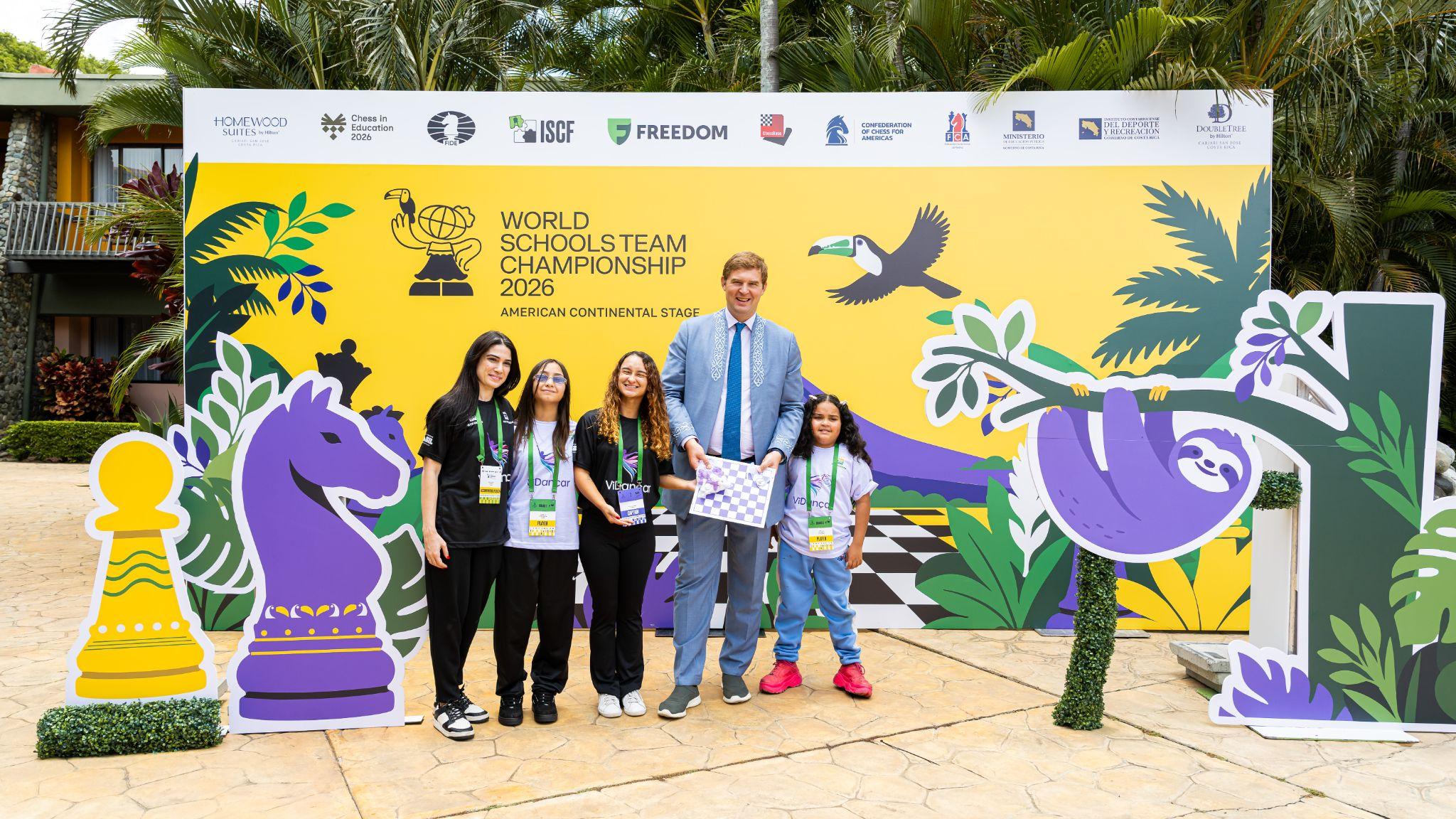
Day three of the American Continental Stage of the FIDE ISCF World Schools Team Championship 2026 brought rounds five and six to the DoubleTree by Hilton Cariari in San José, and one team took the day apart. Saco Oliveros de Lince began it level at the top with Harvest Park Middle School and Crescent Heights Academy, and by the evening they had beaten both of them and stood alone two match points clear. Behind them the race for the qualifying places is now the story, with four teams inside a single match point going into the final day. Round 5 Harvest Park Middle School 1-3 Saco Oliveros de Lince The first two teams in the field met on table one, level on 7 match points and level on 13 game points, and Peru won it 3-1. On board one, Marcos Beltrán Meneses Morales (pictured below) from Saco Oliveros de Lince beat Harvest Park Middle School’s Zhuoyuan Wu in a Caro-Kann. White came out of the opening with a small but real advantage, then lost it to an inaccurate move order, and later overextended on the kingside in a way that left weaknesses on both wings. Black took hold of the position, White faltered in defence, and by the time White gave up the queen simply to stay alive the game was already gone. Black was too far ahead in material and White resigned. Board two saw FM Patrick Liu, the highest rated player in the championship, against Dante Iván Vilca Contreras. Neither player made a mistake. Both finished on 99 per cent accuracy and the draw was the natural result of it, the best chess played anywhere in the round. Board three produced the same accuracy figure for both players and rather less drama, a series of trades into a dry endgame that neither side could do anything with, and a threefold repetition ended it. It was also a meeting of two unbeaten records: Ethan Sun and WCM Fabiana Jiménez Salas had both won all four of their games, and each dropped a first half point to the other. On board four, Rihanna Irina Rojas Salas controlled the game from the start, made a passed pawn on the queenside, promoted it, and delivered mate with it. Crescent Heights Academy 2½-1½ Saint Gabriel’s School Canada came through the other top match, and the two lower boards decided it. On board one, FM Lucas Mason Pin Qian Yao from Crescent Heights Academy had a pleasant position out of the opening and then misplayed it, and at the critical moment chose an aggressive plan that looked strong but allowed Black to neutralise into balance. Tobias Passmore Bowman held the endgame from there, defending in time trouble with his opponent fifteen minutes ahead on the clock. On board two, Vicente Muñoz Venegas (pictured below) outplayed Adela Sun, and the game was decided after only 18 moves. That left boards three and four to the two higher rated Canadians, and both delivered. On board four, CM Andrew Yin met an opposite-side castling opening that burned out quickly once the queens came off; White then misplayed into a passive defence, could not shake it in the endgame, and Black converted. Both Yins remain on a full score after five rounds. Position of the round 2r1r1k1/1p2q1p1/pP2ppp1/1bPpP3/3N4/P3Q1P1/5P1P/1RR3K1 b – – 3 28 Board three, another Caro-Kann and a passive one for Black, produced the finish of the round. Felipe Brunstein Hauyon played 28…Bc4 here, trying to hold on to the bishop, and it is the losing move. 28…fxe5 29.Nxb5 axb5 30.Rxb5 Qd7 followed by …e4 keeps everything under control. Instead Aiden Yin, with White, found 29.c6!, and after 29…bxc6? 30.b7! the rook had to go to b8, when 31.Nxc6 forked the queen on e7 and the rook on b8. A piece up with a passed pawn on b7 that the a-pawn later joined, White converted without fuss and took the point that decided the match. Colombus American School beat Creative Kids Learning Academy 3-1 to move into third, William Nicolás Rodríguez winning again on board one to stay perfect. Colegio Madre del Divino Pastor beat Harrison College School 2½-1½, with Jasmany Shallom Castillo Romero beating AIM Jeremiah Farley on the top board and Charis Stuart losing for the first time, which ended the last of the Barbadian full scores. Colegio Celta Internacional beat The Oxford School by the same margin, CM Fernando Cortes Medina winning a fifth game from five. The best result for the hosts came further down the hall, where Colegio Bilingüe San Francisco de Asís swept Escuela Internacional Sampedrana 4-0, the first clean sweep by a Costa Rican school all week. Colegio Humboldt drew 2-2 with Red Bay Primary School and the British School lost 1½-2½ to Martin Klein Schiller. St. Kitts International Academy, who had not won a match since joining the event, beat Projeto Vidançar 2-0. Round 6 That left boards three and four to the two higher rated Canadians, and both delivered. On board four, CM Andrew Yin met an opposite-side castling opening that burned out quickly once the queens came off; White then misplayed into a passive defence, could not shake it in the endgame, and Black converted. Both Yins remain on a full score after five rounds. Position of the round 2r1r1k1/1p2q1p1/pP2ppp1/1bPpP3/3N4/P3Q1P1/5P1P/1RR3K1 b – – 3 28 Board three, another Caro-Kann and a passive one for Black, produced the finish of the round. Felipe Brunstein Hauyon played 28…Bc4 here, trying to hold on to the bishop, and it is the losing move. 28…fxe5 29.Nxb5 axb5 30.Rxb5 Qd7 followed by …e4 keeps everything under control. Instead Aiden Yin, with White, found 29.c6!, and after 29…bxc6? 30.b7! the rook had to go to b8, when 31.Nxc6 forked the queen on e7 and the rook on b8. A piece up with a passed pawn on b7 that the a-pawn later joined, White converted without fuss and took the point that decided the match. Colombus American School beat Creative Kids Learning Academy 3-1
WSTC Americas Day 2: A Tightening Race in San José
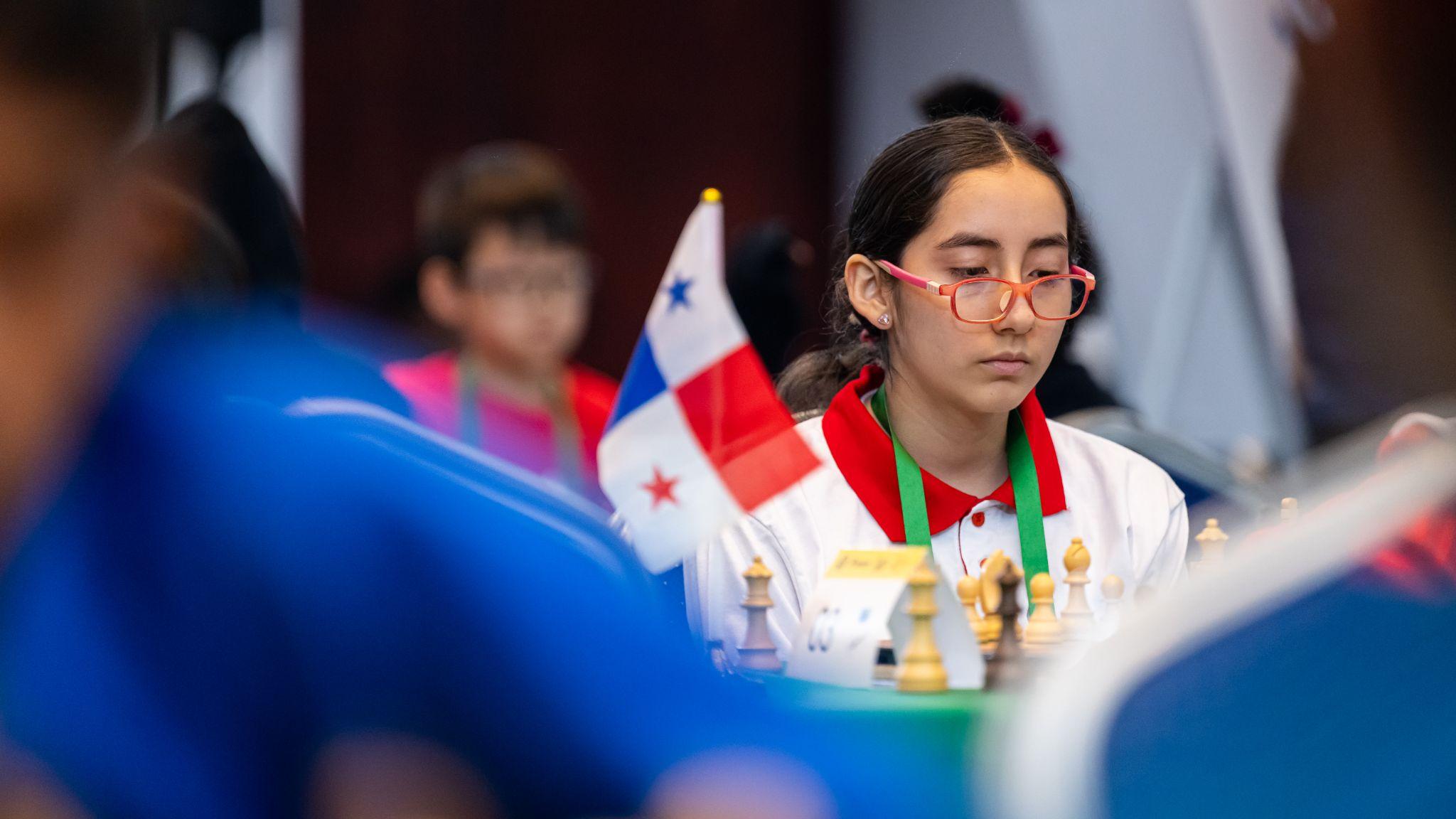
Day two of the American Continental Stage of the FIDE ISCF World Schools Team Championship 2026 brought rounds three and four to the DoubleTree by Hilton Cariari in San José, and ended with three teams sharing the lead and nobody able to break clear. Round 3 The two matches at the top decided the shape of the day. Harvest Park Middle School beat Saint Gabriel’s School of Chile 3-1, losing only on the bottom board, where Martín Muñoz Venegas beat Ruyi Hu in a meeting of players rated identically at 1501. Canada’s Crescent Heights Academy took the other 3-1, over Harrison College School of Barbados, with FM Lucas Mason Pin Qian Yao beating AIM Jeremiah Farley on board one. Both winners now had three from three, and Harvest Park lead on game points, 11 to 9. Behind them, Saco Oliveros de Lince answered their Round 2 draw with a 4-0 sweep of Panama’s The Oxford School, and Colegio Madre del Divino Pastor of El Salvador beat Colombus American School 2½-1½, although William Nicolás Rodríguez won again on the top board, this time against Jasmany Shallom Castillo Romero. Queen’s College, who had beaten Mexico in the opening round, lost 1-3 to Cuba’s Martin Klein Schiller. It was a much better day for the hosts. Colegio Humboldt recorded a second consecutive 4-0, this time against Uruguay’s Colegio y Liceo Nuestra Señora del Verdún, and the British School beat Honduras’s Escuela Internacional Sampedrana 3-1. Only Colegio Bilingüe San Francisco de Asís lost, 1½-2½ to Mexico’s Colegio Celta Internacional. The field also grew. Projeto Vidançar of Brazil joined the championship as the 29th team and lost 0-4 to Academia Inter Metro of Puerto Rico, while St. Kitts International Academy took the bye. Position of the round 2r1r1k1/1p3ppp/p5q1/2b1P3/2NBn3/1P1Q4/P3RPPP/R5K1 b – – 2 22 The biggest individual upset of the round came on the top board of match nine, where Aimar María Murillo Mathiew, rated 1450, beat Juan Esquibel, rated 1792, as Colegio Humboldt swept Nuestra Señora del Verdún 4-0. The game had been anything but smooth, with the advantage changing hands repeatedly. In this position Black tried something clever with 22…Nxf2, and the idea behind it is worth seeing. After 23.Qxg6 Black has 23…Nh3+ in reserve, and if White takes with 24.gxh3 then 24…Bxd4+ arrives with check, after which Black recaptures the queen on g6 and comes out level. But 24.gxh3 was never forced. White simply stepped aside with 24.Kf1, and the whole construction collapsed: Black now has a knight on h3 and a bishop on c5 both hanging, no checks to fall back on, and still has to spend a move taking the queen. A piece down, Black resigned a few moves later. A cool sidestep in a position where neither player had much time left. Round 4 The two unbeaten teams met at the top and could not be separated. Harvest Park Middle School and Crescent Heights Academy drew 2-2, the Americans taking the top two boards and the Canadians the bottom two, where Aiden Yin and CM Andrew Yin both won. Board one was the meeting the draw had been building towards: FM Patrick Liu, at 2292 the highest rated player in the championship, against FM Lucas Mason Pin Qian Yao, the second highest at 1969. It was the sharpest game of the round, with the two players castling on opposite sides and sending their pawns at each other’s kings, and Liu came through it. That draw let Saco Oliveros de Lince join them. Peru’s top seeds beat Colegio Madre del Divino Pastor 3-1, although Marcos Beltrán Meneses Morales lost on board one to Jasmany Shallom Castillo Romero. Standings after four rounds Three teams share the lead on 7 match points: Nine players on a full score Nine players have won all four of their games, and the three teams at the top of the table supply two apiece. For Harvest Park Middle School they are FM Patrick Liu, the highest rated player in the championship, and Ethan Sun. For Crescent Heights Academy, Aiden Yin and CM Andrew Yin. Saco Oliveros de Lince are carried by two girls, WCM Fabiana Jiménez Salas and Rihanna Irina Rojas Salas, who between them have taken eight points from eight while the Peruvian top boards have dropped three games. The other three are CM Fernando Cortes Medina of Colegio Celta Internacional, Charis Stuart of Harrison College School, and William Nicolás Rodríguez of Colombus American School, whose four wins have come against the strongest opposition of any of them: Meneses Morales, Castillo Romero and Chaz Reifer-Belle in the last three rounds alone. A day for the side programme The competitive programme ran alongside a full afternoon of side events. For Harvest Park Middle School they are FM Patrick Liu, the highest rat The day’s headline activity was “Smart Moves: Girls Who Lead”, a girls’ chess event organised by the International School Chess Federation and the Confederation of Chess for the Americas within the framework of the championship. It paired a seven-round Swiss blitz, at 3 minutes plus a 2-second increment for girls aged 16 and under, with a masterclass by WIM María Elena Rodríguez, a member of the Costa Rican Women’s National Team, who spoke about her own path in chess and about confidence, perseverance and success on and off the board. Twenty players took part, and one of them did not drop a half point. WCM Larissa Mayorga Araya won with a perfect 7 out of 7, ahead of Alana Patricia Castro Campos on 6 and Keilym Francinnie Durán Araya on 5. Every girl who played went home with a gift to mark the occasion ed player in the championship, and Ethan Sun. For Crescent Heights Academy, Aiden Yin and CM Andrew Yin. Saco Oliveros de Lince are carried by two girls, WCM Fabiana Jiménez Salas and Rihanna Irina Rojas Salas, who between them have taken eight points from eight while the Peruvian top boards have dropped three games. The other three are CM Fernando
Smart Moves Americas: Governments That Think Ahead
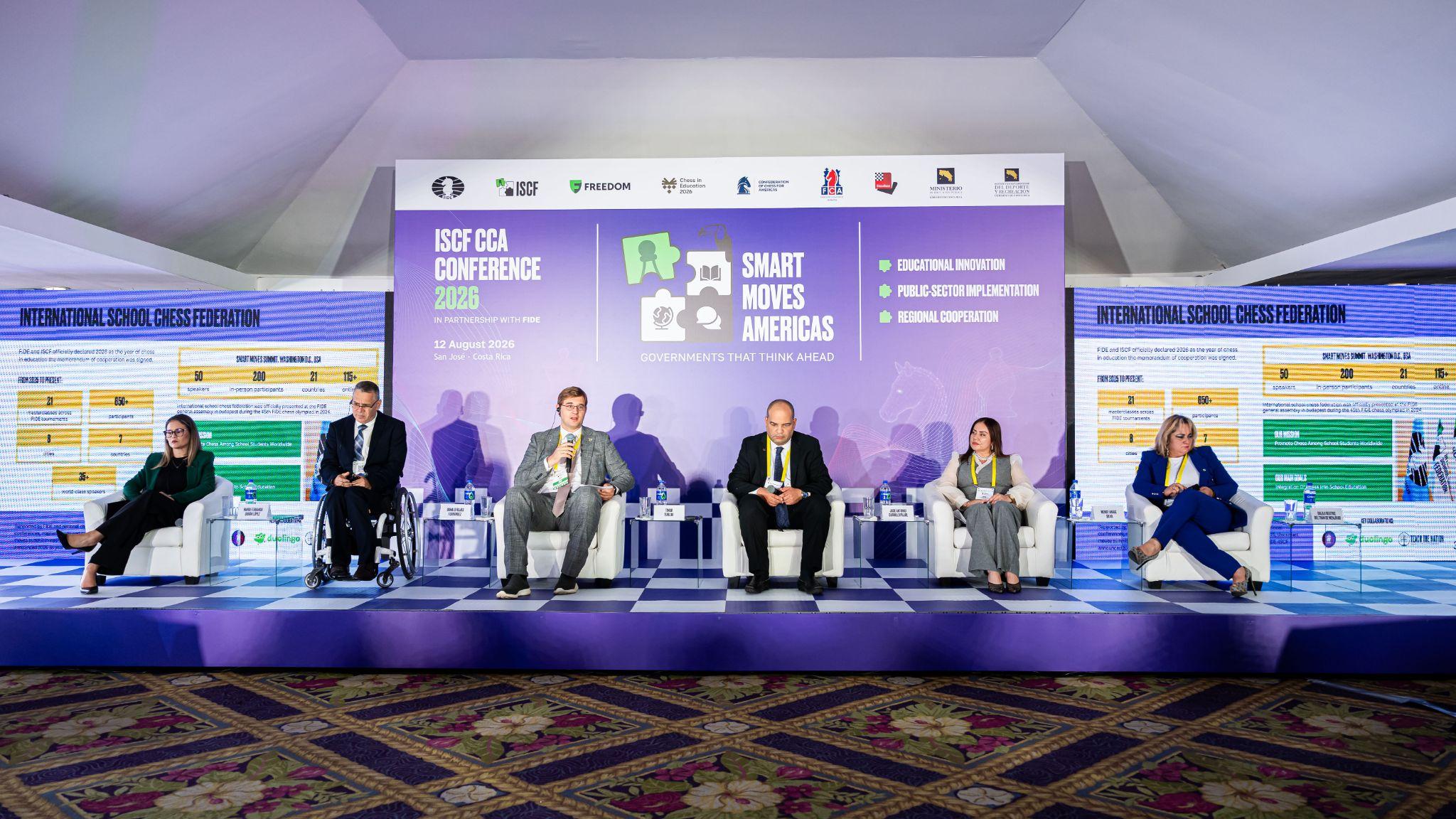
While the first moves were being made at the World Schools Team Championship, a second conversation was taking place a short distance away. At the Cariari Country Club in Heredia, ministers of education and sport, government officials, federation presidents and school leaders from across the Americas gathered for “Smart Moves Americas: Governments That Think Ahead”, the ISCF and CCA conference on chess as public policy. Costa Rica was a natural place to hold the conversation. In 2022 the country passed Law No. 10187, establishing chess instruction in public schools as a matter of national significance, and the current Chess in Education 2026 initiative has taken that statute into practice with a pilot programme in ten government schools, supported by FIDE, the CCA and the Ministry of Public Education. From Vision to National Action The programme opened with a high-level panel on turning educational policy into practice: – Timur Turlov, President of the ISCF and CEO of Freedom Holding – José Antonio Carrillo Pujol, President, FIDE Americas (CCA) – Mendy Aráuz Silva, Minister of Education of the Republic of Nicaragua – Dalila Beatriz Beltrán de Menjívar, National Director of School Coexistence, MINEDUCYT, El Salvador Mendy Aráuz Silva described how Nicaragua has built chess into public education as a pedagogical tool rather than an extracurricular one. In 2026 the country reopened 2,503 primary school and 825 secondary school chess clubs, involving 41,688 students. It distributed 10,000 methodological guides and 1,700 chess kits, and now trains teachers, advisers and instructors nationwide. The case she made for it was not competitive but cognitive and social: logical thinking, concentration, discipline and respectful coexistence. Dalila Beatriz Beltrán de Menjívar took a similar line from El Salvador, presenting chess as a tool that goes well beyond competition. In her account it belongs in the school as a way of strengthening coexistence and the values that hold a classroom together, among them respect, self-control, empathy and the peaceful resolution of conflict, with plans to widen the programme to more schools and communities across the country. “Chess in Education” School Awards The panel was followed by the “Chess in Education” School Awards, recognising schools leading the way in chess education. The honours went to GSD International School Costa Rica in La Guácima, Alajuela, to Escuela Lepanto in the Peninsular regional education directorate, and to Escuela Las Lagunas in Pérez Zeledón. They were presented by Luis Eduardo The conference also saw the signing of a Memorandum of Understanding among the participating ministries, FIDE, the ISCF and the CCA, setting out a shared roadmap for chess in education across the region. Playing the Long Game The dialogue continued with a round table on what it takes for a programme to last beyond a single administration: – Mauricio Arias Santana, moderator – Robert McLellan, Interim Executive Director, National Scholastic Chess Foundation – Andrea Marshall-Harris, International Director, Barbados Chess Federation – Milagros Ibáñez, General Director of Complementary Education, Municipality of Vicente López, Argentina – Dilda Nauryzbayeva, Director of Educational Projects, International School Chess Federation One Board. Millions of Classrooms. The programme closed with a panel on scaling chess as an educational tool: – Dr. Amelia Hernández, moderator – Natalia Lobo, President of the Education Commission, Costa Rican Chess Federation – Marta Amigó Vilalta, Coordinator of the “Chess in School” project, Catalonia – Mery Lizbeth Del Carmen Ceballos Rodríguez, Co-founder, Chess Logistic Speaking at the conference, ISCF President Timur Turlov tied the championship’s purpose to Costa Rica’s own history: “Almost 80 years ago, Costa Rica did something unthinkable: it abolished its army and sent that money to schools and hospitals. This country bet on something stronger than any weapon, on an educated person. Today we continue that same conversation, with a sharper question: what exactly should a school teach so that a child grows up thinking? Our answer is right here, at these boards.” The organisers set out the aim of the day as a shared roadmap for expanding chess in education across the Americas, supported by new partnerships, practical priorities and coordinated regional action. The American continental stage of the World Schools Team Championship continues at the DoubleTree by Hilton Cariari, where the teams these policies are written for were spending the day at the boards.
San José Opens the Board: The WSTC American Continental Stage Kicks Off
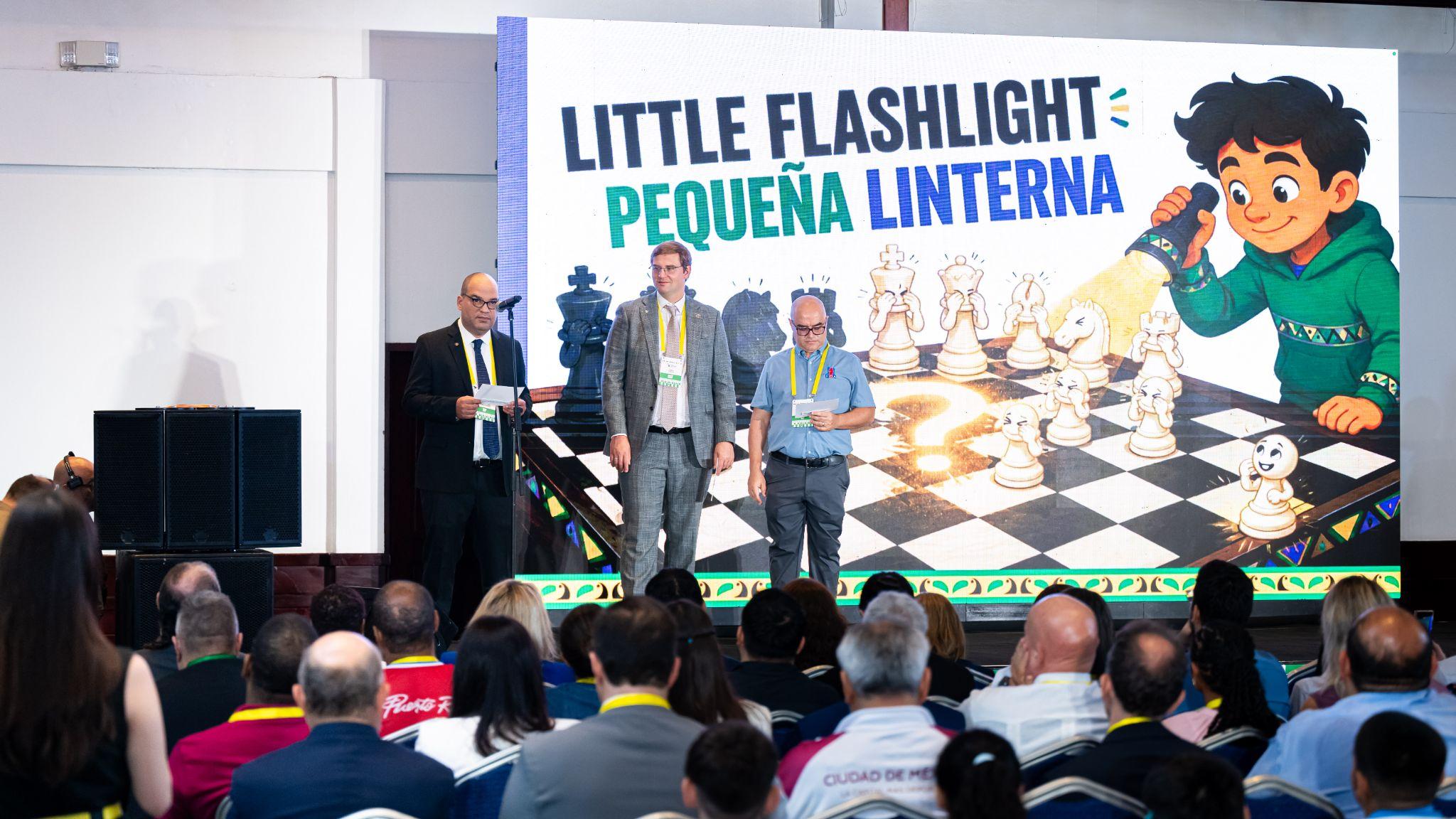
The American Continental Stage of the FIDE ISCF World Schools Team Championship 2026 began today at the DoubleTree by Hilton Cariari in San José, the first time the championship has come to Central America. 29 school teams have travelled here from 25 countries, from Canada to Argentina and across the Caribbean, each of them playing for a place in the Grand Final later this year. The stage falls within the Year of Chess in Education and is supported by Freedom Holding Corp. and the Costa Rican Institute of Sport and Recreation (ICODER). Format Each team fields four main players and one reserve, with both boys and girls represented. The tournament follows an eight-round Swiss system, with a time control of 45 minutes plus a 10-second increment per move from move one. Competitive play begins in the coming days; the opening day was given over to ceremony, dialogue and getting to know one another. At the top of the starting rankings is Peru’s Saco Oliveros de Lince (average rating 1889), followed by the USA’s Harvest Park Middle School and Canada’s Crescent Heights Academy. The host country, Costa Rica, is represented by three schools, led by Colegio Bilingüe San Francisco de Asís. Here is a closer look at the day’s activities. A Special Opening Ceremony The championship opened at 10:00 at the DoubleTree by Hilton Cariari. Following the guests’ registration, the Costa Rican national anthem and the FIDE anthem, three officials took to the stage, but not to deliver speeches. Instead, José Antonio Carrillo Pujol (President, FIDE Americas, CCA), Timur Turlov (President of the ISCF and CEO of Freedom Holding) and Luis Eduardo Quirós Rojas (President of the Costa Rican Chess Federation) opened a message from the young players of the African Continental Stage, part of a growing tradition in which the children of one stage pass the chess relay on to the next. This time the African players sent not ordinary letters but a “package”, unwrapped on screen item by item. Inside were several small symbolic gifts, each carrying a wish, a piece of advice and a dose of humour: a chess compass, a flashlight, a magnet, an AA battery, a salt shaker of “lightness”, and an extra, empty suitcase. As each official opened a gift, the children’s words set a warm and personal tone for the week ahead. Opening the “compass,” Timur Turlov read: “We are sending you a chess compass. It does not point north or south. It points in the direction of your next good move… We wish everyone to find their own direction at this championship and make at least one move that takes you where you truly want to go.” Opening the “flashlight,” José Antonio Carrillo Pujol read: “Sometimes the position seems dark and unclear, and all the moves are like in a fog. Then take the flashlight and look at the board from a different angle… Sometimes the best move is visible only in semi-darkness, when your eyes have adjusted and are not distracted by flickering.” Unwrapping the “magnet,” Luis Eduardo Quirós Rojas read: “The magnet doesn’t work from fear. If you are nervous and fidgety, it repels everything good. But if you breathe evenly and trust your calculation, it pulls the right moments toward you… The main thing — don’t bring the magnet near your rating. It doesn’t attract that. Only your mood and attention.” The final card left the young players with a thought to carry through the week: “You are not just participants. You are part of a great chess story that began long before you and will continue after you. Happy playing, champions!” The ceremony closed with the symbolic first move, made by Timur Turlov (President of the ISCF and CEO of Freedom Holding) and José Antonio Carrillo Pujol (President, FIDE Americas – CCA), officially declaring the American Continental Stage open. Round 1 The opening round saw a stable start. Seven of the thirteen matches finished 4-0, which is common enough on the first day of a schools team event, where the seeding gap between the top and the bottom of the field is at its widest. Top seed Saco Oliveros de Lince swept Costa Rica’s Colegio Bilingüe San Francisco de Asís, and Harvest Park Middle School did the same to Paraguay’s Colegio Cristo Rey. The result of the round came on board five, where Queen’s College of Barbados, seeded 18th, beat Mexico’s Colegio Celta Internacional 3-1. Mexico took the top board through CM Fernando Cortes Medina, but Queen’s College won the other three, with Jaeda Herbert and Nathan Simmons-Patterson both beating higher rated opponents. It was a difficult start for the hosts. None of the three Costa Rican schools won. San Francisco de Asís was swept by Peru, Colegio Humboldt lost 1-3 to Saint Gabriel’s School of Chile with only Nicolás Ramírez Quirós scoring, and the British School took the day’s only drawn match, holding Colegio Madre del Divino Pastor of El Salvador 2-2. Position of the round R1b2r2/1p3pkp/nbp1pN2/5p2/1qBP4/5N1P/1BQ2PP1/5RK1 w – – 2 20 Board one of the top match produced the finish of the round. Marcos Beltrán Meneses Morales of Saco Oliveros de Lince, playing White, helped his team to their 4-0 sweep with a game he had taken control of in the opening. White is winning here and has more than one good continuation, but the young Peruvian found the most attractive. 20.d5! opens the b2 bishop’s diagonal towards the black king on g7, setting up a discovered check the moment the knight on f6 moves. In such overwhelming positions it is easy to rush; instead White brought another piece into the attack. The game continued 20…cxd5 21.Nxd5+ Kh6, and White finished with 22.Qc1+ Kg6 23.Qg5#, the queen protected by the knight on f3 and every escape square covered. Round 2 Round 2 produced the upset the opening round had not. Top seed Saco Oliveros de Lince was held to 2-2 by Colombus American School of Colombia, who won both of the top boards: William Nicolás Rodríguez
Costa Rica Takes Center Stage for School Chess in the Americas

San José, Costa Rica — August 11, 2026 Chess doesn’t usually make morning sports radio. This week it did. Ahead of the American Continental Stage of the World Schools Team Championship (WSTC), three of the people behind the event sat down with Teletica Deporte Radio’s “Tren Deportivo” — and a 15-minute slot turned into a 36-minute conversation. That tells you something about how much there is to say. The tournament From August 11 to 16, the DoubleTree Hilton Cariari becomes home to the best school chess on the continent: 29 school teams from across the Americas, competing for a place in a global grand final against the other continents. The tournament is organized by FIDE and the International School Chess Federation (ISCF), together with the Costa Rican Chess Federation and the Chess Confederation for the Americas (CCA), with the backing of the Costa Rican Institute of Sport and Recreation (ICODER). It runs under the banner of the 2026 Year of Chess in Education, an initiative supported by Freedom Holding Corp. Andrei Vodianov, Chief Operating Officer (COO) of the ISCF, explained where the federation came from. It was founded barely two years ago on an idea from its president, Timur Turlov, a father of six who wanted to promote school chess worldwide the way it’s done in Kazakhstan. FIDE’s General Assembly approved it in 2024. Last year the ISCF ran its first WSTC in Washington, D.C. – a single global championship. This year the format changed. Instead of bringing the whole world to one place, the championship splits into four continental stages, opening the door to far more countries. Africa’s stage was held in Cape Town last month. Costa Rica is the American stage. Each host nation gets three teams. Costa Rica’s spots go to Colegio Humboldt, San Francisco de Asís (from Guápiles) and Colegio Británico — the top three from a national stage that drew more than thirty schools, played for the first time in a new team format: four players per school, with at least one boy and at least one girl on every team. Accreditation opens August 11. The opening ceremony and Round 1 follow on Wednesday, August 12, with rounds running through August 15 — Mother’s Day in Costa Rica — and the closing ceremony that Saturday. Continental champions advance to a grand final in December, staged alongside the FIDE World Blitz and Rapid Championship, where players like Magnus Carlsen and Hikaru Nakamura compete. The conference The competition is only half of it. On August 12, the ISCF hosts the Smart Moves Americas Summit — a conference of panels with world-class experts on chess as an educational tool, including a roundtable, “Playing the Long Game,” and a session pointedly titled “One Board, Millions of Classrooms.” It’s the kind of event that normally costs at least $100 to attend. Here it’s free and open to anyone who wants to come. “They’re covering everything,” said Mauricio Arias Santana, who chairs the Education Commission of the Chess Confederation for the Americas. “So the impact reaches everyone.” Registration links are on the Costa Rican Chess Federation’s social channels – the link. Why it matters Behind the boards and the panels is a bigger idea and that’s really what the three guests came to talk about. For Luis Quirós Rojas, president of the Costa Rican Chess Federation, the headline is simple: chess is the fastest-growing sport in the country’s schools, according to official statistics. But the pitch to educators isn’t about adding to their plate. “We’re not telling teachers, ‘I want you to do more’ — they already do a great deal,” Quirós said. “We’re telling them: here’s a tool to make your job easier.” He pushed back on the old playground wisdom that chess makes kids smart. “Is a child fast because he runs? No — he’s fast because he built the ability by running,” he said. “In the same way, we want every child who goes to school in Costa Rica to build abilities by playing. And the Ministry of Education is telling us: yes, come in, there’s room.” Arias, an international master before he turned to promoting the game, spoke about it in personal terms. “I have a good life. For me and my family, none of it would have been possible without chess,” he said. “I don’t know what hole I’d be in — but we certainly wouldn’t be having this conversation.” He also captured why so many countries are watching Costa Rica right now. “A few years ago we had to go to countries and convince them this was worth doing,” he said. “Today they’re not asking whether it works. They’re asking how to implement it — what’s the method.” Costa Rica, he added, is “putting itself at the head of the continent” on chess in education: curricula are being written, and a pilot is about to launch in several schools. For Vodianov, the reason to keep going is more personal. At the Asian stage, a team of four girls from a very rural region of India played the first time any of them had ever left their city. “Situations like that give us the drive to keep going,” he said. (The story is on the ISCF’s Instagram.) Arias left the radio audience with the line that summed it up best. “Everything we’re talking about here is an investment in talent,” he said. “And to be clear — not chess talent. Talent as a country.” The World Schools Team Championship — American Continental Stage runs August 11–16, 2026, at the DoubleTree Hilton Cariari, Costa Rica. Organized by FIDE and the International School Chess Federation with the Costa Rican Chess Federation and the Chess Confederation for the Americas, endorsed by ICODER, under the 2026 Year of Chess in Education supported by Freedom Holding Corp.
Registration opens for European Continental Stage of FIDE ISCF World Schools Team Championship 2026
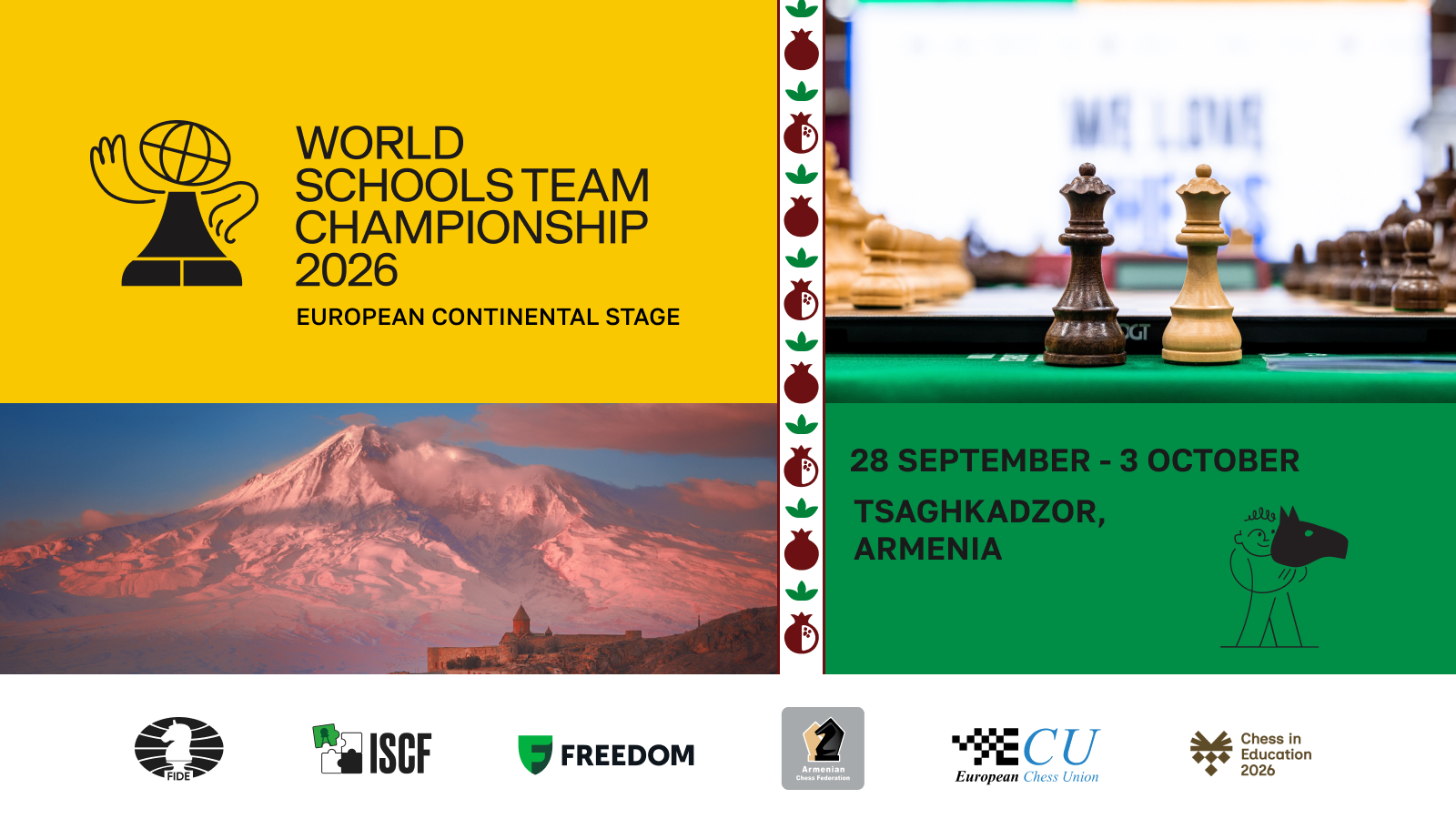
FIDE and the International School Chess Federation (ISCF), with the support of its general partner Freedom Holding Corp., invite all FIDE member federations from Europe to participate in the European Continental Stage of the FIDE ISCF World Schools Team Championship 2026 (WSTC 2026). Organized by ISCF and FIDE jointly with the Armenian Chess Federation and the European Chess Union, the event will be held in Tsaghkadzor, Armenia, from September 28 (arrival) to October 3 (departure), 2026. The European Continental Stage will become one of the continental qualifiers of the new World Schools Team Championship cycle held within the framework of the Year of Chess in Education 2026 initiative. The best teams will qualify directly for the WSTC 2026 Grand Final, where the continental champions will compete for the title of FIDE ISCF World Schools Team Champion 2026. Team composition and eligibility Each team shall consist of: four main players; one reserve player; one non-playing captain. Each team must include at least one boy and at least one girl, except in specific cases provided for in the Regulations for single-gender educational institutions. Players eligible to participate must be born between January 1, 2012 and December 31, 2018. National federations are responsible for confirming that all players are officially enrolled in the educational institution they represent during the 2025–2026 academic year. The tournament will be played over eight rounds using the Swiss system. Participation conditions and organizer support Within the framework of the Championship, selected teams will receive organizer support, including: full-board accommodation; airport and local transfers; 4 economy-class flight tickets for designated eligible delegations. Detailed participation conditions are outlined in the official Invitation Letter and General Regulations. Educational and cultural programme In addition to the tournament itself, participants and guests will take part in a special educational and cultural programme organized in line with the Year of Chess in Education 2026 initiative. The programme will include: masterclasses and lectures by leading chess players and educators; interactive workshops; side activities promoting educational exchange and intercultural dialogue. The Championship aims not only to identify the strongest school team on the continent but also to promote chess as a powerful educational and social development tool. Registration The registration deadline is August 28. National federations are kindly encouraged to complete the registration process at the earliest opportunity, as the number of places in the tournament is limited. Organizer support conditions outlined in the Regulations are available only for the first 20 teams fully registered in compliance with the official requirements. Teams may register only through their respective FIDE member federations using the official online registration form. Registration form: http://worldschoolteam2026.fide.com/registration-stage-europe/ Contact e-mail: worldschoolteam@fide.com Official website: https://worldschoolteam2026.fide.com/ Invitation Letter: http://worldschoolteam2026.fide.com/files/WSTC_2026_Invitation_Letter_European_Stage.pdf
Costa Rica to Host the American Continental Stage of the World Schools Team Championship 2026
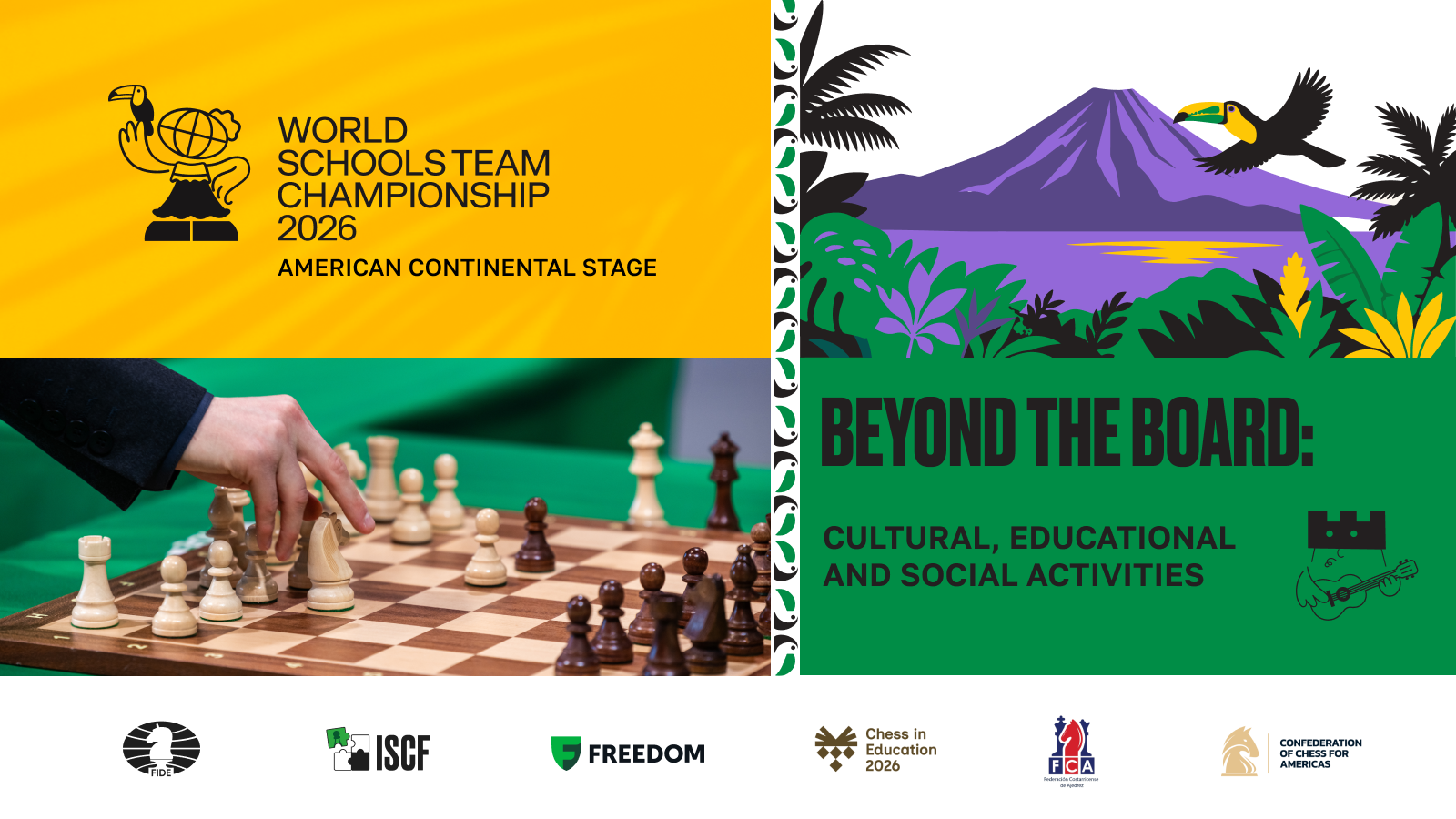
San José, Costa Rica — For the first time, Central America takes its place on the world chess map. From 11 to 16 August 2026, San José will welcome the best young minds of a continent as Costa Rica hosts the American Continental Stage of the FIDE-ISCF World Schools Team Championship 2026 (WSTC). Held at the DoubleTree by Hilton Cariari, the championship gathers top school teams from across the Americas: from Mexico to Peru, from Jamayca to Barbados – each competing for a place in the Grand Final against the champions of the other continental stages. It is a historic milestone. Never before has this stage of the World Schools Team Championship been held in Costa Rica or Central America, and its arrival turns San José into a meeting point for youth, education and sport at the highest level. Organised by the International Chess Federation (FIDE) and the International Schools Chess Federation (ISCF), together with the Costa Rican Chess Federation and the Confederation of Chess for the Americas (CCA), the event takes place within the framework of the Year of Chess in Education 2026, a joint FIDE-ISCF initiative, supported by Freedom Holding Corp., that brings chess into classrooms and national education systems around the world. Chess That Lasts Beyond the Final Move The FIDE ISCF World Schools Team Championship 2026 – American Continental Stage brings together the strongest school teams from across the Americas. But the championship is also a meeting point for educators, policymakers, federations and families who share a common belief: chess has an important role to play in shaping how children learn. Held during the Year of Chess in Education 2026, the event reflects a growing global movement. Around the world, countries are integrating chess into education to strengthen critical thinking, decision-making, resilience and creativity. The championship creates an opportunity not only to compete, but to exchange experience, strengthen partnerships and help successful ideas reach more schools and more children. Smart Moves Americas: Governments That Think Ahead A central part of the championship week is Smart Moves Americas: Governments That Think Ahead, the ministerial conference organised by the International School Chess Federation and the Confederation of Chess for the Americas. Held on 12 August at the Cariari Country Club as a flagship event of the Year of Chess in Education 2026, officially declared by FIDE and ISCF, the conference will bring together ministers, education authorities, curriculum leaders, teacher-training specialists, government representatives and international partners to exchange proven practices, strengthen regional partnerships and support the sustainable expansion of Chess in Education across the Americas. The conference focuses on practical experience rather than theory. Participants will explore national case studies, teacher development, curriculum integration and approaches that have already demonstrated results in different education systems. Delegations are expected from across the region, including representatives from Costa Rica, Barbados, El Salvador, Panama, United States, the Dominican Republic and other countries of the Americas, creating an unprecedented regional platform for policy dialogue and professional exchange. The conference program includes: Registration & Networking Coffee Opening Ceremony From Vision to National Action – a ministerial panel exploring national leadership, policy development and successful government initiatives. Memorandum Signing Ceremony – reinforcing regional cooperation and long-term collaboration in Chess in Education. Launch of the Beacons League School Certification Program – a joint initiative introducing the first certification framework for Costa Rican schools implementing Chess in Education. Chess School Awards – recognising schools demonstrating outstanding leadership and innovation in Chess in Education. Networking Lunch Playing the Long Game: Building Sustainable Chess in Education – exploring the foundations of long-term success in Chess in Education, from policy and partnerships to funding, teacher capacity, localisation and evidence, with perspectives from countries at different stages of implementation. Networking Coffee One Board. Millions of Classrooms. – bringing together education experts and curriculum specialists to explore teaching methodologies, interdisciplinary learning, classroom practices and innovative ways to embed chess across the curriculum. Smart Moves Americas is designed to connect those who shape education policy with those who shape classroom practice. By bringing together decision-makers and education practitioners in the same room, the conference creates a shared space where successful experiences can be exchanged, adapted and transformed into long-term regional cooperation. Learning Beyond Competition Throughout the championship, participants will have access to a comprehensive educational program designed for students, teachers, parents, coaches and federation officials. The week includes: Smart Moves: Girls Who Lead, developed in partnership with the Confederation of Chess for America, promoting the participation and empowerment of girls and women in chess through a girls’ masterclass and blitz tournament. Chess in Subject, demonstrating practical ways to integrate chess into classroom teaching across different subjects. ISCF Master Class Series – Raising Champions: From Talent to Title, exploring long-term player development and the role of families, coaches and schools. Simul with a Twist, an interactive simultaneous exhibition where spectators become part of the game through collective decision-making. Kahoot Chess Quiz, bringing together learning and competition in an engaging format. Sustainability and community initiatives, including environmental activities and collaborative sessions developed with international partners. Every activity has been designed with the same objective: helping participants leave with new knowledge, new ideas and new connections that continue long after the championship has ended. A stage for the continent The championship will be attended by senior officials and distinguished guests from across the Americas, including José Antonio Carrillo Pujol, President of FIDE Americas (CCA); Hon. Chad J. Blackman, M.P., Minister of Educational Transformation of Barbados; Dalila Beatriz Beltrán de Menjívar, National Director of School Coexistence at MINEDUCYT, El Salvador; and Andrea Marshall-Harris, International Director of the Barbados Chess Federation — alongside educators and speakers such as Robert McLellan (National Scholastic Chess Foundation, USA) and WFM Amelia Hernández (USA/Venezuela). For Costa Rica, the tournament is more than a sporting occasion. It is an opportunity to showcase the country’s commitment to youth, education and international cooperation — and to welcome the continent to a week where every young player, whatever the result, leaves with something that lasts.
Sr. Miriam Duggan Primary School (Uganda) Takes Gold at African Continental Stage of World Schools Team Championship
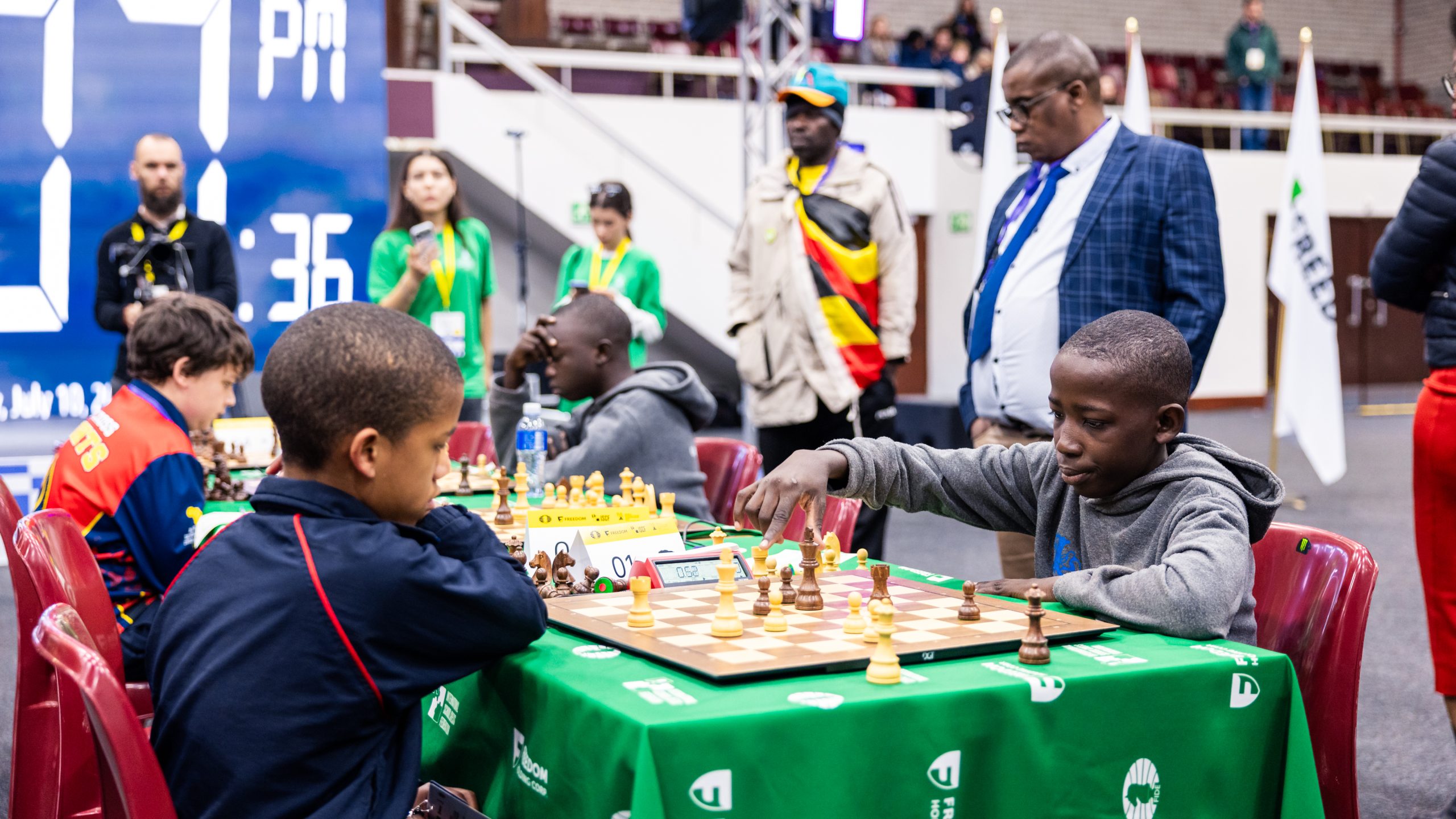
Add Your Heading Text Here There was a different feeling inside the Coetzenburg Center on Friday morning. The music still played as the players filed in, and the smiles were still everywhere, but beneath it was the awareness that they were doing this for the final time. Two last rounds remained in Stellenbosch, with the African continental title and three places at the Grand Final in December still to be decided. The day would bring to a close a week that had offered far more than tournament results: new friendships between players from across the continent, evenings filled with masterclasses and workshops, and, for many, a first opportunity to represent their school internationally. By the end of the day, the top seeds had delivered. Sr. Miriam Duggan Primary School of Uganda were crowned African continental champions after completing the tournament without losing a match. Kenya’s Moi Nyeri Complex Primary School took silver, while the host nation also had reason to celebrate as Welgemoed Primary School secured bronze. All three teams qualified for the Grand Final in December. Rounds 7 and 8 Uganda’s Sr. Miriam Duggan Primary School and Kenya’s Moi Nyeri Complex Primary School began the final day level on 10 match points, with five teams two points behind. Round 7 kept the two leaders together. Uganda defeated Madagascar’s Lycée Privé Hibiscus 4-0, recording their second clean sweep of the event, while Kenya beat Namibia’s Windhoek Afrikaanse Privaatskool 3-1. Both teams moved to 12 match points with one round remaining. Having already faced each other earlier in the tournament, they could not be paired again under the Swiss system. The title would therefore be decided in separate matches and, should both teams achieve the same result, on tiebreaks. Behind them, the contest for the third and final Grand Final place narrowed to two South African schools. Welgemoed Primary School defeated Angola’s Instituto Industrial 3½-½, while Holy Cross Primary won its all-South African match against Virginia Preparatory School 3-1. The results moved both teams to 10 match points, two ahead of a six-team group on eight. Shortly before the final round, the Kenyan players gathered around their boards for a last talk from their coach. With arms around one another’s shoulders, they listened closely before heading into Round 8 with renewed energy. Uganda left no room for doubt. Paired against Holy Cross Primary, the top seeds won 3½-½ to finish on 14 match points from a possible 16. Their final record stood at six match wins, two draws and a tournament-best 24½ game points. “I’m so humbled for this fantastic performance. I believe in my boys because we are the top seed, the best in the country, the best in the region. These are kids from an academy in the ghetto, disadvantaged kids, vulnerable to all the problems that come with that. I trained them so that they can get the opportunities that come with chess. Chess is improving them, they are moving around the world, and I’m so proud that wonderful brains from such areas can serve our country and the entire world,” said Patrick Mukasa, coach of Sr. Miriam Duggan Primary School and founder of the Kamwokya Teens Chess Club and Academy, where the players train. For Kenya, the final round brought considerably more tension. They appeared to have control of their match against Zimbabwe’s Budiriro 4 Primary School, but the momentum shifted and the encounter ended 2-2. The dropped match point proved to be the difference between gold and silver. There was little disappointment visible afterwards, however. The Kenyan players left the stage smiling, their mood as light as it had been during the morning huddle. For three members of the team, the connection extends beyond the chessboard. Davidson, Trevor and Patricia Waweru are siblings, and after the match they spoke about learning the game together, improving alongside one another and enjoying the chance to compete as a family. That shared experience had taken them all the way to Stellenbosch and a silver medal. The contest for the third Grand Final place produced another close finish. Welgemoed led Namibia 2-1 with one game still in progress. The final board featured a complicated position, with qualification depending on the result. Welgemoed eventually lost the game, leaving the match tied 2-2 and prompting anxious calculations at the team’s table. The draw was enough. Welgemoed finished on 11 match points, one ahead of Holy Cross, to claim bronze and become South Africa’s representative at the Grand Final. Before the closing ceremony, the final afternoon still belonged to the players starting with a chess quiz in the Lectorium at 16:00. The activity rooms hosted a drumming masterclass, national and group games, and one final session in the entertainment zone, while a cooking masterclass completed the programme. Some players will return home with medals and qualification places. All of them leave Stellenbosch having represented their schools on an international stage and shared the week with young players from across Africa. A farewell to Stellenbosch The championship ended as it had begun: with players, coaches, parents and officials gathered together. At 20:30, they returned to the venue for the official closing ceremony, which opened with gratitude to those who made the week possible. Chief among them was the Freedom Group of companies, the main sponsor of the African Continental Stage and General Partner of the International School Chess Federation, whose backing, alongside that of ISCF President and Freedom Holding Corp CEO Timur Turlov, has carried the championship from an idea to four continental stages reaching young players around the world. Thanks also went to the African Chess Confederation, Chess South Africa, the Department of Cultural Affairs and Sport of the Western Cape Government, Stellenbosch University and ChessBase, a valued partner who prepared special gifts for every participant. A highlights video looked back on the four days in Stellenbosch before the national anthem of South Africa, performed by Onele Mngameli, and the FIDE anthem. Representatives of the participating federations then presented the individual board
“The Best Event I Have Ever Been To”: Day 3 in Stellenbosch
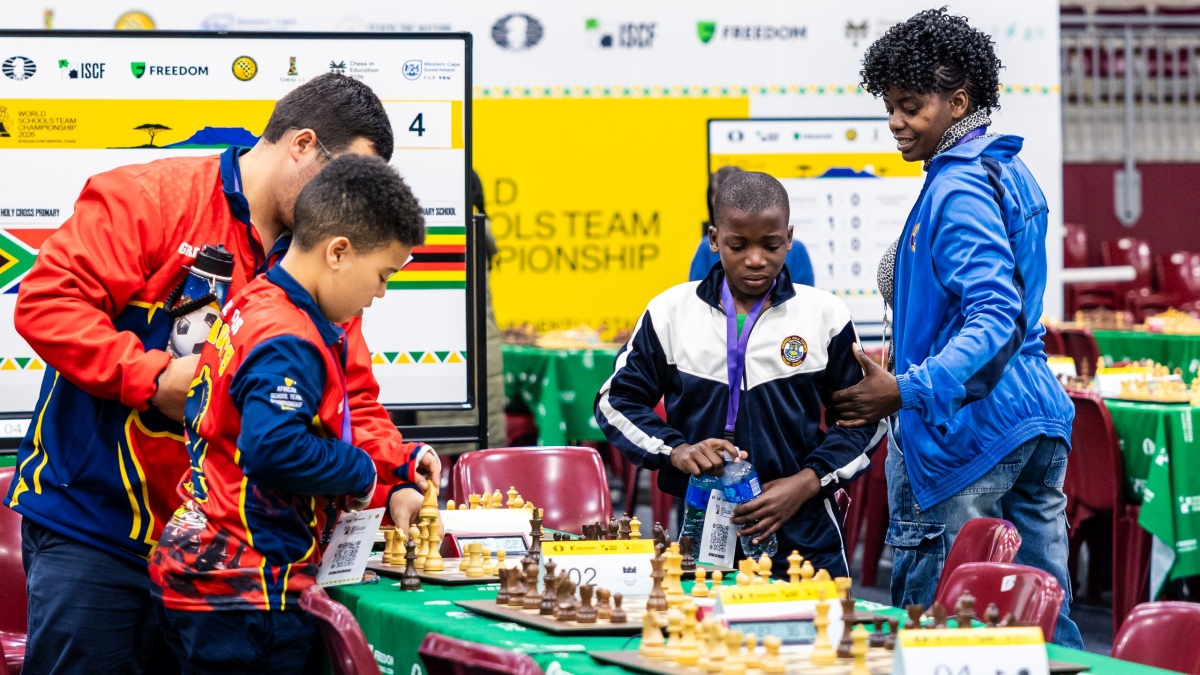
Add Your Heading Text Here Day three of the African Continental Stage of the FIDE ISCF World Schools Team Championship 2026 brought rounds five and six to the Coetzenburg Center, pushing the tournament into its decisive phase. With only two rounds remaining after today’s play, every match carried greater weight. The leading teams were looking to protect their positions, while those close behind still had an opportunity to enter the race for the title and qualification places. The championship’s wide-ranging programme reflects the support behind it. Freedom Holding Corp., the main sponsor of the African Continental Stage and General Partner of the International School Chess Federation, has helped create a week that combines serious competition with education, personal development, and opportunities for young players to connect beyond the board. Rounds 5 and 6 Round five narrowed the race at the top, with Kenya and Uganda both securing important victories. Kenya’s Moi Nyeri Complex Primary School produced the strongest result among the leading teams, defeating Madagascar’s Lycée Privé Hibiscus 3½-½. Uganda’s Sr. Miriam Duggan Primary School also kept pace with a 3-1 victory over Zimbabwe’s Budiriro 4 Primary School. With Kenya and Uganda both moving to nine match points, the afternoon round was set to play a major role in separating the leaders. In round 6, Angola’s Instituto Industrial held Uganda to a 2-2 draw, and the shock of the day came on board one, where unrated Melquesideque Paulo defeated Ronald Wabwire, the highest-rated player in the field. Manuel Carlos added a second Angolan win against 1727-rated Trevor Tumukunde before Daniel Odokonyero and WCM Juliet Asaba rescued the match point for the top seeds. Kenya fared no better: Welgemoed’s AFM Wolf van der Merwe beat Davidson Waweru on board one, and though Trevor Waweru and Irwin Ndegwa kept up their form in the middle, Adiaan Vlok levelled the match at 2-2 on board four. Heading into the final day, Uganda and Kenya share the lead on 10 match points, with five teams closely behind them: Madagascar, Angola, Welgemoed, Holy Cross, and Namibia all on eight. With two rounds to play, nothing is settled. Player spotlight: Ronald Wabwire At just 12 years old, Uganda’s Ronald Wabwire is already regarded as one of his country’s brightest young chess talents. Rated 2174 and competing on board one for Sr. Miriam Duggan Primary School, he entered the championship as its highest-rated player. Wabwire’s achievements include winning the Under-12 title at the 2026 African Youth Chess Championship with eight points. At the age of nine, he also recorded a perfect 7/7 score to win the 2023 Jumuiya Africa Mashariki Chess Championship. Despite the expectations surrounding him, Wabwire’s strongest impression of the week was not about ratings or results. Asked about his experience in Stellenbosch, he summed it up in one sentence: “This is the best event I have ever been to.” Team spotlight: Zimbabwe At the other end of the starting ranks sits one of the tournament’s best stories. Sengwa Primary School from rural Gokwe, in Zimbabwe’s Midlands Province, arrived in Stellenbosch as the 29th and final seed, and as the only all-girls team in the field: Grade Seven pupils Vimbai Bhamu, Makanaka Chirefu, and Rebecca Siposo, and Grade Five learner Dorcas Gwariro. For several of them, the flight to Cape Town was their first time on an aeroplane, or in an airport at all. “I used to see other children leaving and returning with medals, and I told myself that I should also give it a try,” Siposo told Zimbabwe’s Herald before departure. Their journey carries weight back home. Days before the team left, Zimbabwe’s First Lady, Dr. Auxillia Mnangagwa, whose support along with the ISCF helped secure the team’s place here, was appointed patron of the Zimbabwe Chess Federation juniors. “We promised the First Lady that we will show other nations that a girl can do it. It starts in Zimbabwe and spreads to others,” federation president Todd Mapingire said. The girls have taken that promise seriously: unfazed by the seeding, they have already collected match wins this week, including a 3-1 victory over Malawi’s Bwaila Secondary School in Round 5. Chirefu, who only started playing in 2024, put the bigger picture best: “Chess has helped me improve my mathematics because it has strengthened my problem-solving skills. When I come back, I want to teach other children.” Side Events: Raising Champions While the tournament continued at the boards, the educational programme returned to the Lectorium of Stellenbosch University. Dr. Denise Bouah presented a session titled “Raising Champions,” continuing the championship’s focus on the development of young players beyond their results. The programme has created space throughout the week for conversations about guidance, growth, and the role that parents, coaches, and communities play in helping children thrive. Breaking barriers through chess The final workshop of the day, “Breaking Barriers: Challenging Stereotypes Through Chess,” was held in collaboration with Teach The Nation and brought players, parents, coaches, captains, and supporters together in the playing hall. Through interactive activities and discussion, participants explored how experiences from the chessboard can support personal development beyond the game. The session looked at challenging stereotypes, building confidence and resilience, and strengthening communication between young players and the parents and coaches supporting them. Participants also reflected on the importance of teamwork and encouragement, as well as the character developed through both victories and defeats. The workshop encouraged those in attendance to view chess not only as a competition, but as a way to build stronger relationships, meaningful connections, and skills that extend into everyday life. Away from the formal programme, the activity spaces once again filled with players looking to relax after two demanding rounds. National and activity games took place in Activity Room 2, while Activity Room 1 hosted a handcraft masterclass. After six rounds of competition, these shared spaces have become an important part of the championship experience. They give players the chance to meet opponents from other countries, spend time with teammates, and enjoy the event without the