
Baby Shark, Big Upsets, and a Three-Way Lead in Stellenbosch.
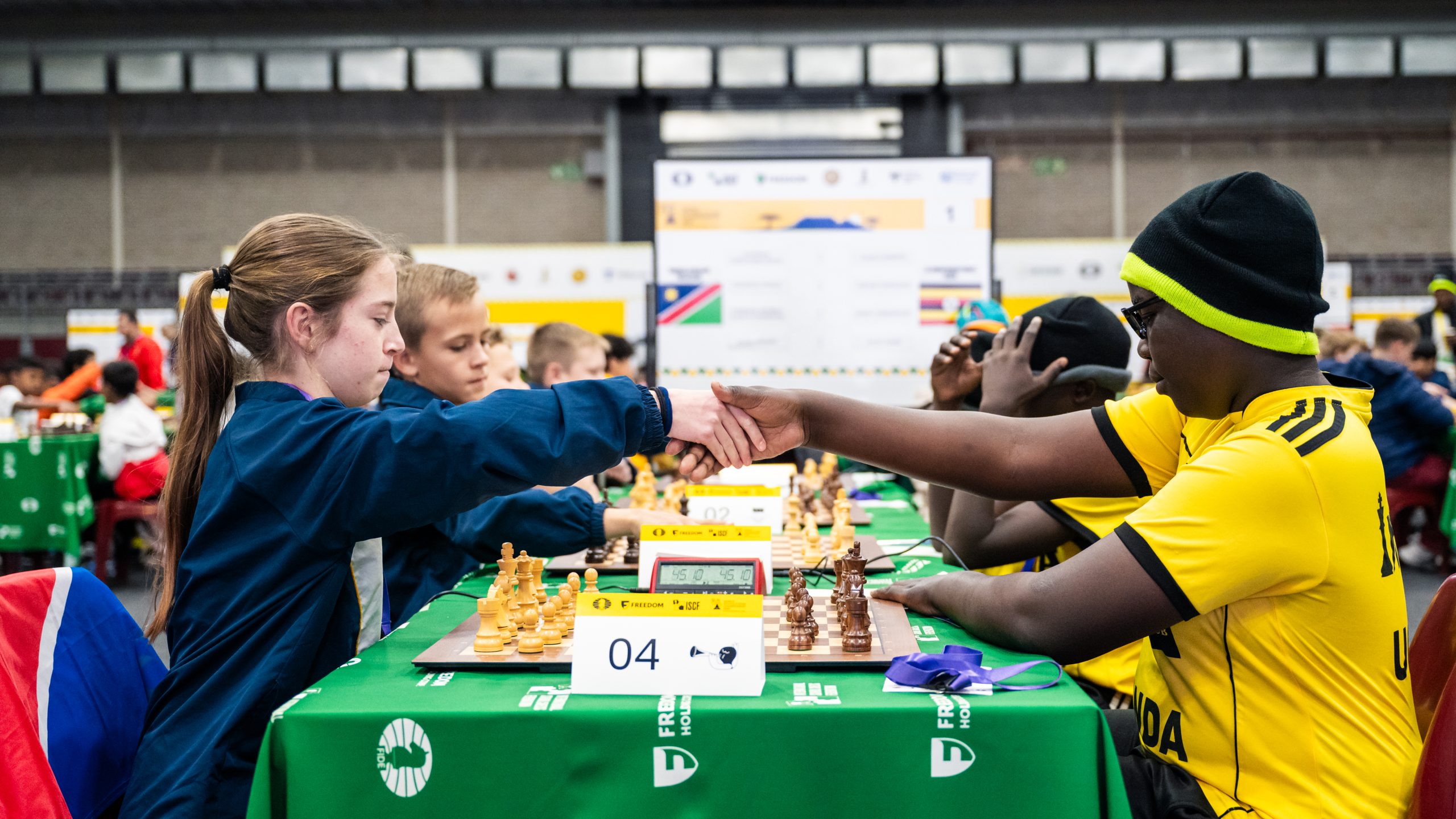
Baby Shark, Big Upsets, and a Three-Way Lead in Stellenbosch. Day two of the African Continental Stage of the FIDE ISCF World Schools Team Championship 2026 brought rounds three and four to the Coetzenburg Center in Stellenbosch, and a day that reshaped the top of the standings. The two remaining teams with perfect scores, Uganda and Kenya, met in the fourth round and drew. By the end of the day, three teams shared the lead, although the mood inside the playing hall remained anything but heavy. Energetic music greeted the players as they streamed into the venue, setting the tone for the day. Then, just before round three, Chief Arbiter Gunther van den Bergh made an unusual announcement: he asked everyone to rise for an anthem. The students stood, exchanging confused looks, before the opening notes of Baby Shark rang out across the hall. Laughter erupted, and the arbiters joined the children in performing the familiar dance moves. Speaking as the round got underway, Van den Bergh, whose idea it was, explained that he knew how tense the opening minutes of a game could feel and wanted to help the players relax and settle in. He was onto something – when several young players were interviewed before the round and asked how they felt ahead of their games, the most common answer was “nervous”. Watching those same faces laughing and dancing only minutes before the clocks started was a sight to see. Rounds 3 and 4 Round three brought the first meeting between teams with perfect scores, and top-seeded Uganda made a statement. Sr. Miriam Duggan Primary School swept Namibia’s Windhoek Afrikaanse Privaatskool 4-0, while fourth-seeded Kenya, represented by Moi Nyeri Complex Primary School, defeated Ghana’s Delhi Public School 3½-½. The results left Uganda and Kenya as the only two teams with a perfect six match points, setting up a round-four showdown at the top of the table. The encounter lived up to expectations. Kenya and Uganda traded blows across all four boards before finishing level at 2-2. Uganda’s highest-rated players delivered on the outside boards, with Ronald Wabwire (2174) winning on board one and WCM Juliet Asaba (1985) prevailing on board four. Kenya’s middle order, however, struck back with two major upsets. Trevor Waweru (1478) defeated Trevor Tumukunde (1727) in the battle of the Trevors, while Irwin Ndegwa (1474) took down Daniel Odokonyero (1944). The draw opened the door at the top of the standings, and Madagascar’s Lycée Privé Hibiscus stepped straight through it, defeating Angola’s Instituto Industrial 3-1 to join Uganda and Kenya in the lead on seven match points. STANDINGS A simul with a twist The side programme delivered one of its most anticipated events in the evening: a simultaneous exhibition by International Master Henry Robert Steel at the Lectorium of Stellenbosch University. The format came with an unusual twist. While Steel faced his opponents in the traditional one-against-many setup, one board was played collectively by the audience. Spectators voted on each move, with the majority decision then played on the board. Before the simul, the Lectorium hosted a masterclass by a man whose story many of the players already knew, even if they did not know his name. Robert Katende, founder of the SOM Chess Academy in the Ugandan slum of Katwe, is the coach whose mentorship of Phiona Mutesi inspired the film Queen of Katwe. His talk, “Chess as a Tool for Life Development”, drew directly on that journey. Katende spoke about chess as a way of teaching children to plan, recover from setbacks, and believe that their circumstances do not determine their future. It was a message that could hardly have found a more fitting audience than the young players at this championship, several of whom come from the very programmes his work helped inspire. Away from the Lectorium, the entertainment zone maintained its now-familiar buzz. PS5 consoles, air hockey, foosball, table tennis, cornhole, giant chess, and giant Jenga ran from late afternoon, alongside badge-making and the national and activity games in Activity Room 2. For many of the players, the hours after the rounds have quickly become as much a part of the championship experience as the games themselves. Rounds 5 and 6 take place tomorrow, 9 July, where the competition and pressure will only get tougher as the end reaches nearer. The event is supported by Freedom Holding Corp., the main sponsor of the African Continental Stage and General Partner of the International School Chess Federation. Its continued commitment helps make both the competition and the wider educational and cultural programme possible. Written by Charlize van Zyl
First Moves in Stellenbosch: African Continental Stage of the World Schools Team Championship 2026 Begins
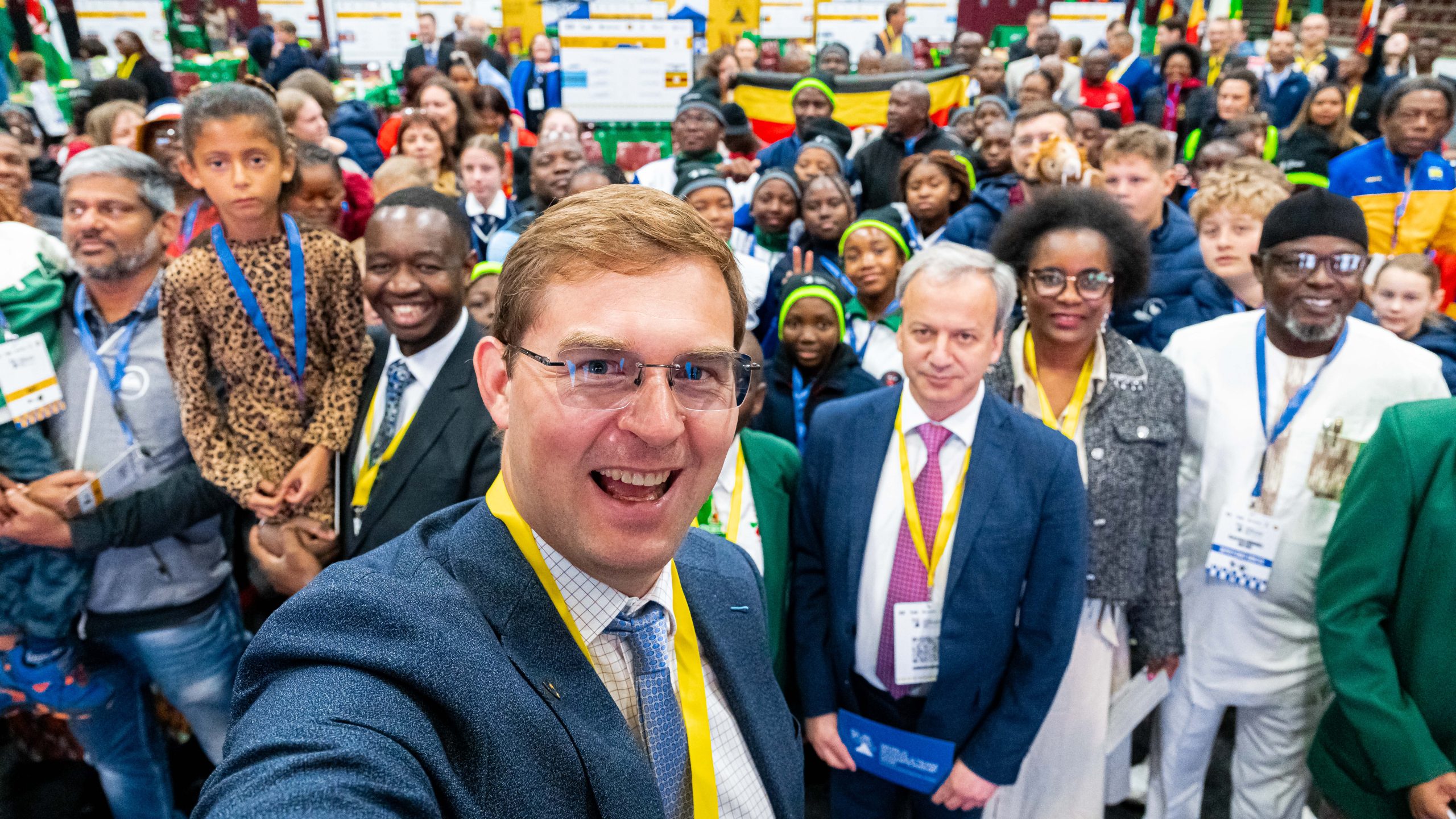
First Moves in Stellenbosch: African Continental Stage of the World Schools Team Championship 2026 Begins The tournament opened at 10:00 with a ceremony that “set protocol aside”. Following introductory remarks, the South African national anthem and the FIDE anthem, FIDE President Arkady Dvorkovich, ISCF President Timur Turlov, African Chess Confederation President Tshepiso Lopang, and Chess South Africa President Andre Lewaks took the stage, but not to deliver speeches. Instead, each official read letters written by young players at the previous stages in Almaty and Washington, answering one question: “What would you say to your fellow players if you were standing on the opening ceremony stage?” Their words about mistakes and victories, friendship without borders, dreams, and a big and open world captured the spirit of the championship better than any formal speech could. The heartfelt messages captivated the audience. Here are some of the most memorable answers: “If you lose, it is okay to feel sad for a little while. But not for too long. Then it is better to look through the game and pretend that learning something was your plan all along.” “Don’t be afraid if you and your opponent don’t speak the same language. In chess, you can understand each other without words — after the first move!” “May each of you have a big chess dream. For example, to become a world champion. Make smart moves! In the game and … in life too!” “I hope that at this championship you look not only at the board, but also around you. Because the world is truly big, and it is wonderful to see it while playing.” Following a group photo under the event’s motto, WE LOVE CHESS, and a dance performance by the Stars of Tomorrow group, President Arkady Dvorkovich officially declared the African Continental Stage open. The ceremony also recognised the essential support of the Freedom Group of companies, whose partnership made the event possible and continues to strengthen chess education and development programmes worldwide. The ceremony set the tone for the day of chess ahead, with smiles and good spirits all around. The players then made their way to the boards for the first round, which began at 11:30. First moves were made by young chess stars – Sophia Smith (8 years old) representing Beaumont Primary School, and Theeran Varadharajan (4 years old) from Alex Blaikie Montessori School. Rounds 1 and 2 The first round produced no major upsets, although several matches ended in draws. There were also a few 4-0 clean sweeps, always an ideal way to begin a team event. Round two followed a similar pattern, although more matches were closely contested. Four teams ended the day with victories in both rounds, and the competition is expected to intensify tomorrow as more evenly matched teams face one another. It should also be noted that the early standings may not yet provide a true indication of strength, given the large number of unrated players who could easily be underestimated. Standings after round 2 The appeal of the World Schools Team Championship lies not only in the games and the stakes of winning. ISCF has also planned a wide range of side events and programmes to engage both the young players and the local community. Today’s schedule included social outreach, a book talk, and numerous fun and entertaining activities. Chess reaches beyond the tournament hall In the afternoon, the focus shifted to the championship’s social outreach programme.The official delegation, including Arkady Dvorkovich, Timur Turlov, Stellenbosch Executive Mayor Jeremy Fasser, Andre Lewaks, and presidents of national chess federations from across Africa, made the short trip to the historic Paul Roos Gymnasium, where 50 learners from three local schools were waiting at the chessboards. The delegates took to the stage to address the children. Although the setting was formal, the remarks were directed warmly towards the young audience. FIDE President Arkady Dvorkovich began by asking, “Who in the audience has lost a chess game?” The question was met with raised hands and laughter. He went on to speak about the connection between chess, life, and learning from defeat: “Chess helped me to acquire skills that are good for day-to-day life. Memory, strategy, thinking about the opponent, but most importantly, that it’s just you and the board. No one can help you; you are responsible for each move and everything that will happen from that move. That is what life is about: we make our moves and we are responsible for them.” Questions were then opened to the audience and ranged from which aspect of chess the officials loved most to who their favourite player was. Each school received a certificate and chess equipment to support its chess programme, while every child went home with a gift. Once the formalities had ended, the VIP guests and federation presidents stood across the boards from the young players for a friendly chess session before everyone gathered outside for a group photo. The visit reflected the central aim of the Year of Chess in Education: bringing the game, and everything it teaches, to more children across the continent. The educational programme also opened today at the Lectorium of Stellenbosch University, where Dr. Lyndon Bouah, a former South African Chess Olympian, national team captain, and author of 14 books on chess history, presented “South Africa at the Chess Olympiads (1958–2022)” and launched his newest book, Namaste: India 2022, on South Africa’s run at the 44th Chess Olympiad in Chennai. Dr. Lyndon Bouah has been a pillar of South African chess for many years, and his talk offered valuable insight into the host nation’s chess history and culture. The fun did not stop when the clocks did. After the round, players poured into the entertainment zone, where PS5 consoles, air hockey, foosball, table tennis, cornhole, giant chess, and giant Jenga kept the competitive spirit alive in a far more relaxed setting. Those looking for a souvenir joined the badge-making workshop, an illusion show added a touch of magic to the evening, and
BEYOND THE BOARD: CULTURAL, EDUCATIONAL, AND SOCIAL ACTIVITIES SET FOR FIDE ISCF WORLD SCHOOLS TEAM CHAMPIONSHIP 2026
Stellenbosch, South Africa — July 2026 The African Continental Stage of the World Schools Team Championship 2026 (WSTC 2026) runs in Stellenbosch from July 6 to 11, with nearly 30 school teams from across the continent arriving to compete. As part of the global WSTC cycle, teams will compete across multiple rounds throughout the week, with the top performers going on to qualify for the WSTC Grand Final later this year. In line with the Year of Chess in Education 2026, the championship features a full educational programme running alongside the competition: masterclasses, workshops, and cultural exchange activities designed to make the week matter long after the final round. The programme opens on July 7 at the Lectorium of Stellenbosch University, where Dr. Lyndon Bouah, former South African Chess Olympian, national team captain, and author of 14 books on chess history, presents South Africa at the Chess Olympiads (1958–2022) and launches his newest book, Namaste: India 2022, on South Africa’s run at the 44th Chess Olympiad in Chennai. Participants will have the opportunity to explore South African chess history, hear behind-the-scenes stories from the Olympiads, and engage with one of Africa’s leading chess historians and sports administrators. On July 8 at 18:00, the Lectorium of Stellenbosch University will also hosts a simultaneous exhibition with a structural twist. International Master Henry Robert Steel will face multiple opponents in the traditional format, with one exception: one board will be contested collectively by the audience. Spectators vote on each move, deliberating openly before the majority decision is played – a format that transforms passive observers into active participants and turns a classic chess tradition into a shared intellectual exercise open to all. July 9 brings two back-to-back sessions at the Lectorium. From 16:30 to 18:00, Dr. Denise Bouah, a Women International Master, three-time South African National Women’s Chess Champion, and sport psychologist, leads “Raising Champions: From Talent to Title,” unpacking the mental side of high performance: focus under pressure, emotional regulation, and the kind of confidence that holds up outside the tournament hall too. The day closes with “Breaking Barriers: Challenging Stereotypes Through Chess,” an interactive workshop run with Teach the Nation, where players examine how the setbacks and victories of the board shape character, and how chess can challenge assumptions and build stronger relationships between players, parents, and coaches. Beyond the official educational programme, the week is packed with activities built to introduce players to South African culture, from local dance and music to hands-on craft sessions. A dedicated lounge zone gives kids a space to unwind between rounds, and a handful of other surprises round out the schedule. Put it all together, and the championship starts to feel less like a tournament and more like a full-blown chess festival for kids. “This isn’t a week where kids just show up, play, and leave,” said the ISCF team. “The masterclasses and the cultural programme are there so they walk away with something. A skill, a perspective, a connection to a place they’d never been before.” The FIDE ISCF World Schools Team Championship 2026 continues through the week in Stellenbosch, with the competitive programme running alongside the full schedule of masterclasses and side events. The championship is supported by Freedom Holding Corp., the international financial and investment group, whose partnership has been instrumental in bringing the full scope of the programme to life. About ISCFThe International School Chess Federation (ISCF) is dedicated to promoting chess in schools worldwide, using the game as a tool for education, personal development, and youth empowerment. ISCF organizes international school chess championships and educational programmes across multiple continents in partnership with national federations and educational institutions. About FIDEThe International Chess Federation (FIDE) is the governing body of world chess, overseeing international competitions, rankings, and the development of chess as a sport and educational tool across the globe.
Health and Safety Statement
The Organizing Committee of the African Continental Stage of the FIDE ISCF World Schools Team Championship 2026 places the highest priority on the health and safety of all participants, guests and officials. The Organizing Committee is closely monitoring the epidemiological situation in the region and remains in close contact with the competent authorities of the Republic of South Africa and the Western Cape. The Committee is guided by, and will strictly follow, the official guidance and recommendations of the responsible health authorities at every stage of the preparation and conduct of the Championship. Medical support will be provided at the competition venue. The Organizing Committee will agree upon and document an appropriate health protocol in advance and will promptly coordinate with the relevant services should the need arise. The Organizing Committee will keep participants and the public duly informed as official guidance becomes available.
Registration opens for the American Continental Stage of the FIDE ISCF World Schools Team Championship 2026
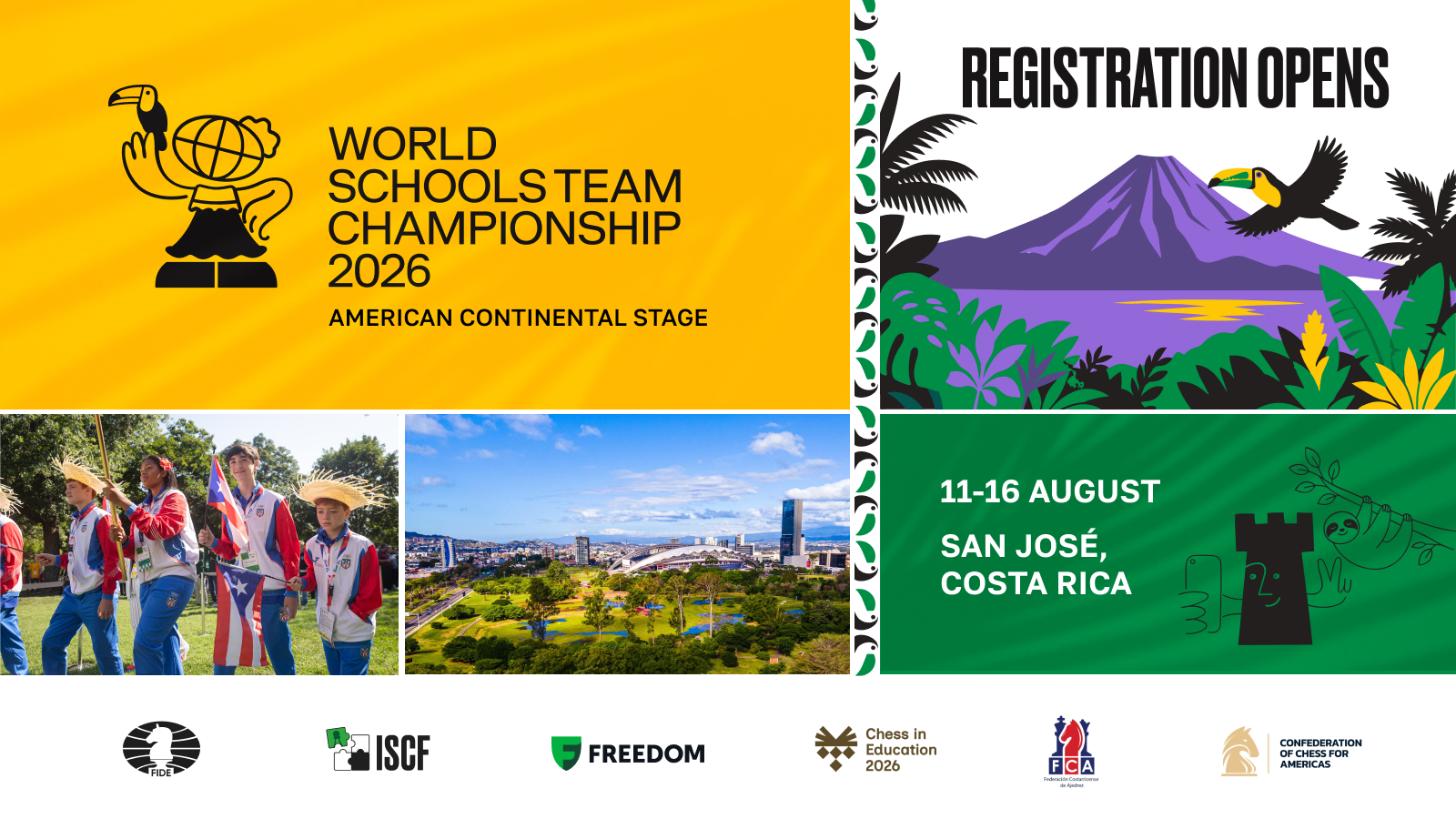
FIDE and the International School Chess Federation (ISCF), with the support of its general partner Freedom Holding Corp., invite all FIDE member federations from the Americas to participate in the American Continental Stage of the FIDE ISCF World Schools Team Championship 2026 (WSTC 2026). The event will be held in San José, Costa Rica, from 11 August (arrival) to 16 August (departure), 2026, and is organized by ISCF and FIDE jointly with the Federación Costarricense de Ajedrez and the Confederation of Chess for America. The American Continental Stage will become one of the continental qualifiers of the new World Schools Team Championship cycle held within the framework of the Year of Chess in Education 2026 initiative. The best teams will qualify directly for the WSTC 2026 Grand Final, where the continental champions will compete for the title of FIDE ISCF World Schools Team Champion 2026. Team composition and eligibility Each team shall consist of: four main players; one reserve player; one non-playing captain. Each team must include at least one boy and at least one girl, except in specific cases provided for in the Regulations for single-gender educational institutions. Players eligible to participate must be born between 1 January 2012 and 31 December 2018. National federations are responsible for confirming that all players are officially enrolled in the educational institution they represent during the 2025–2026 academic year. The tournament will be played over eight rounds using the Swiss system. Participation conditions and organizer support Within the framework of the Championship, selected teams will receive organizer support, including: full-board accommodation; airport and local transfers; economy-class flight tickets for designated supported delegations. Detailed participation conditions are outlined in the official Invitation Letter and General Regulations. Educational and cultural programme In addition to the tournament itself, participants and guests will take part in a special educational and cultural programme organized in line with the Year of Chess in Education 2026 initiative. The programme will include: masterclasses and lectures by leading chess players and educators; interactive workshops; side activities promoting educational exchange and intercultural dialogue. The Championship aims not only to identify the strongest school team on the continent but also to promote chess as a powerful educational and social development tool. Registration The registration deadline is July 16. National federations are kindly encouraged to complete the registration process at the earliest opportunity, as the number of places in the tournament is limited, and organizer support conditions outlined in the Regulations are available only for the first 20 teams fully registered in compliance with the official requirements. Teams may register only through their respective FIDE member federations using the official online registration form. Registration form: http://worldschoolteam2026.fide.com/registration-stage-america/ Contact e-mail: worldschoolteam@fide.com Official website: https://worldschoolteam2026.fide.com/ Invitation Letter: http://worldschoolteam2026.fide.com/files/WSTC_2026_Invitation_Letter_American_Stage.pdf
Registration opens for African Continental Stage of FIDE ISCF World Schools Team Championship 2026
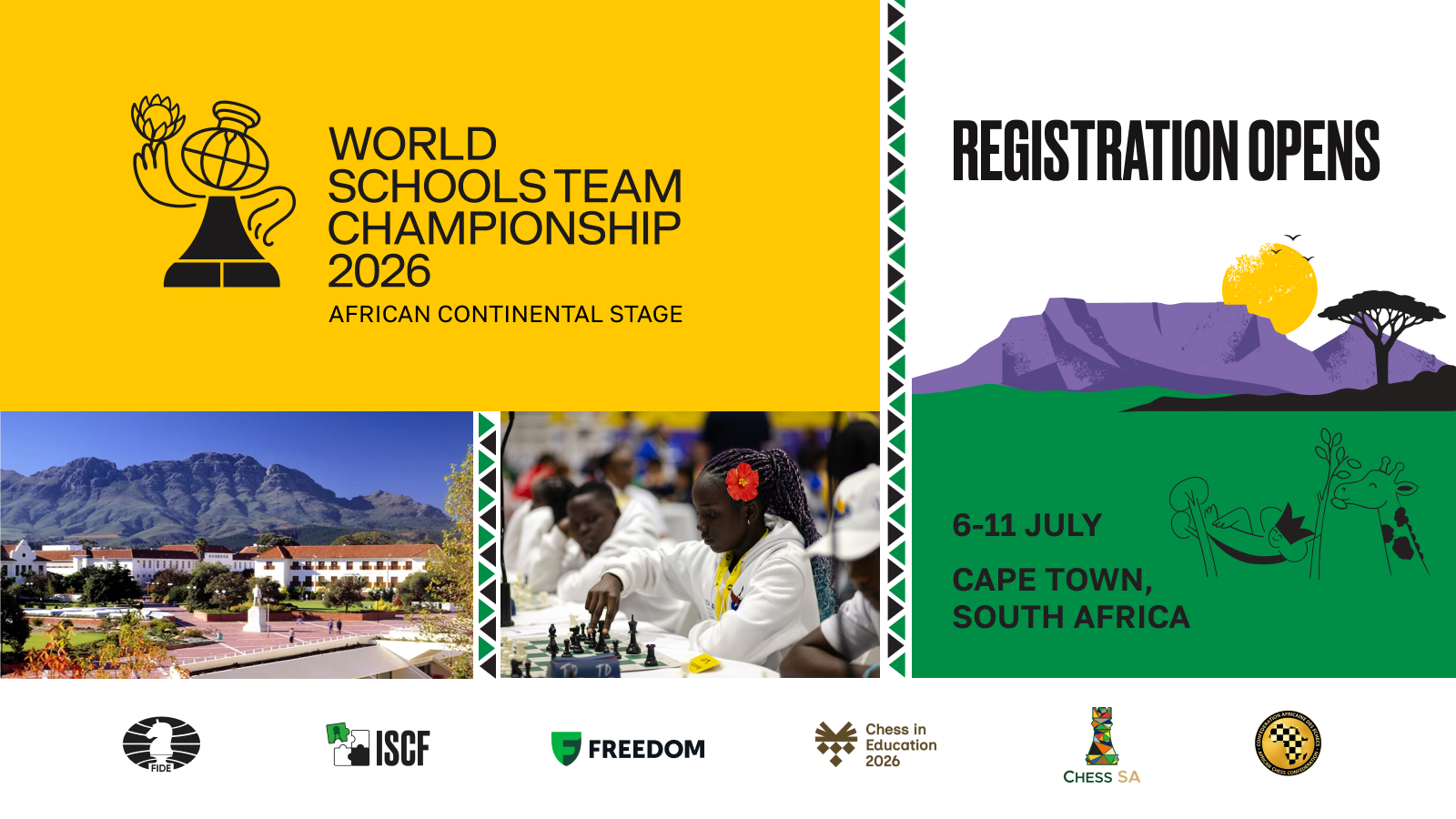
FIDE and the International School Chess Federation (ISCF), with the support of its general partner Freedom Holding Corp. invite all FIDE member federations from Africa to participate in the African Continental Stage of the FIDE ISCF World Schools Team Championship 2026 (WSTC 2026). The event will be held in the Cape Town area, South Africa, from July 6 (arrival) to July 11 (departure), 2026. The African Continental Stage will become the second continental qualifier of the new World Schools Team Championship cycle held within the framework of the Year of Chess in Education 2026 initiative. The best teams will qualify directly for the WSTC 2026 Grand Final, where the continental champions will compete for the title of FIDE ISCF World Schools Team Champion 2026. Team composition and eligibility Each team shall consist of: four main players; one reserve player; one non-playing captain Each team must include at least one boy and at least one girl, except in specific cases provided for in the Regulations for single-gender educational institutions. Players eligible to participate must be born between January 1, 2012 and December 31, 2018. National federations are responsible for confirming that all players are officially enrolled in the educational institution they represent during the 2025–2026 academic year. The tournament will be played over eight rounds using the Swiss system. Participation conditions and organizer support Within the framework of the Championship, selected teams will receive organizer support, including: full-board accommodation; airport and local transfers; economy-class flight tickets for designated supported delegations Detailed participation conditions are outlined in the official Invitation Letter and General Regulations. Educational and cultural programme In addition to the tournament itself, participants and guests will take part in a special educational and cultural programme organized in line with the Year of Chess in Education 2026 initiative. The programme will include: masterclasses and lectures by leading chess players and educators; interactive workshops; side activities promoting educational exchange and intercultural dialogue The Championship aims not only to identify the strongest school team on the continent but also to promote chess as a powerful educational and social development tool. Registration The registration deadline is June 18, 2026. National federations are kindly encouraged to complete the registration process at the earliest opportunity, as the number of places in the tournament is limited, and organizer support conditions outlined in the Regulations are available only for the first 20 teams fully registered in compliance with the official requirements. Teams may register only through their respective FIDE member federations using the official online registration form. Registration form:https://worldschoolteam2026.fide.com/registration-stage-africa Full Invitation Letter, General Regulations and registration details are available at:https://www.fide.com/wp-content/uploads/WSTC-2026-Invitation-Letter-African-Stage-1.pdf Contact e-mail: worldschoolteam@fide.comOfficial website: https://worldschoolteam2026.fide.com/
FIDE and ISCF announce dates for African and American Continental Stages of the World Schools Team Championship 2026
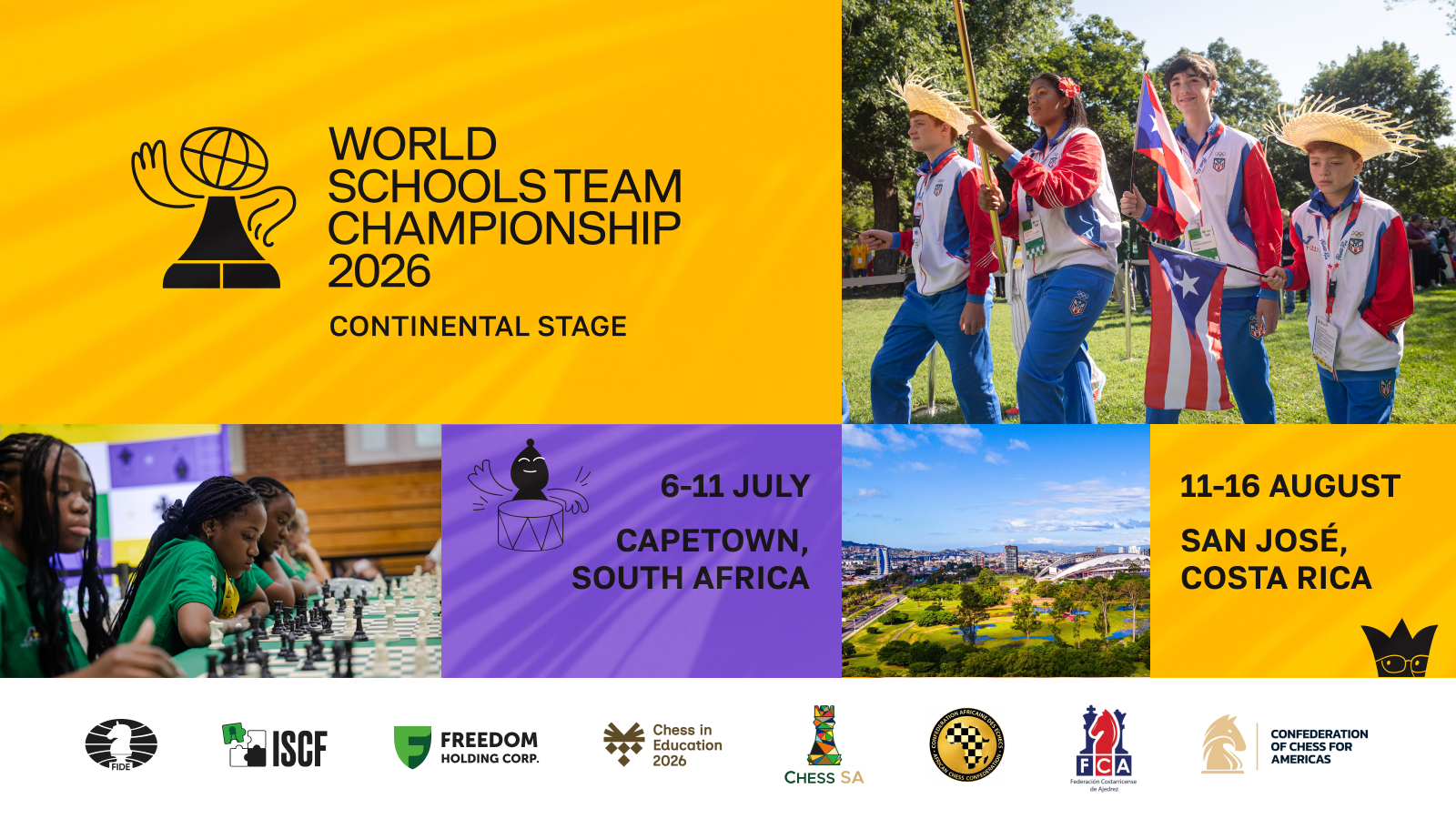
FIDE and ISCF announce dates for African and American Continental Stages of the World Schools Team Championship 2026 FIDE and the International School Chess Federation (ISCF) are pleased to announce the dates for the African and American Continental stages of the World Schools Team Championship 2026 (WSTC 2026). As part of the global WSTC cycle, continental events bring together leading school teams from around the world, with best teams qualifying for the Grand Final at the end of the year. African Continental StageCape Town, South AfricaJuly 6–11, 2026 (arrival: July 6, departure: July 11) American Continental StageSan Jose, Costa RicaAugust 11–16, 2026 (arrival: August 11, departure: August 16) Arkady Dvorkovich, FIDE President: “We are delighted to launch two new continental school championships in Africa and the Americas as part of our Year of Chess in Education. These regions are emerging chess hubs with tremendous potential. In recent years, we have seen significant progress in their chess infrastructure and school programs, and these championships will help drive that growth even further. FIDE will continue to provide support as part of our long-term strategy to expand the game beyond its traditional centers.” Timur Turlov, ISCF President:“I am very pleased to see the expansion of continental school championships to Africa and the Americas. These initiatives are an important step in strengthening youth engagement and building sustainable chess ecosystems in both regions. I look forward to the upcoming events in Cape Town in July and San Jose in August, which will undoubtedly inspire a new generation of players.” The format and competition regulations remain consistent across all continental stages. Each event will be played in a team format under official FIDE regulations, ensuring a high level of sporting and organizational standards. Each participating team must consist of: four main players one reserve one non-playing captain Teams are required to include both boys and girls (with limited exceptions for single-gender schools), and all players must meet the age eligibility criteria as outlined in the Regulations. In line with the Year of Chess in Education 2026, each continental stage will also feature an educational programme alongside the competition, including masterclasses, workshops, and cultural exchange activities. National federations are kindly invited to plan their national selection processes and prepare their teams for participation. Registration for both events will open in due course. Further details, including invitation letters and logistical information, will be published soon. Regulations, schedule (PDF) For inquiries, please contact: worldschoolteam@fide.com Official website: https://worldschoolteam2026.fide.com/
Freedom Holding Corp becomes FIDE Partner for 2026 chess programmes
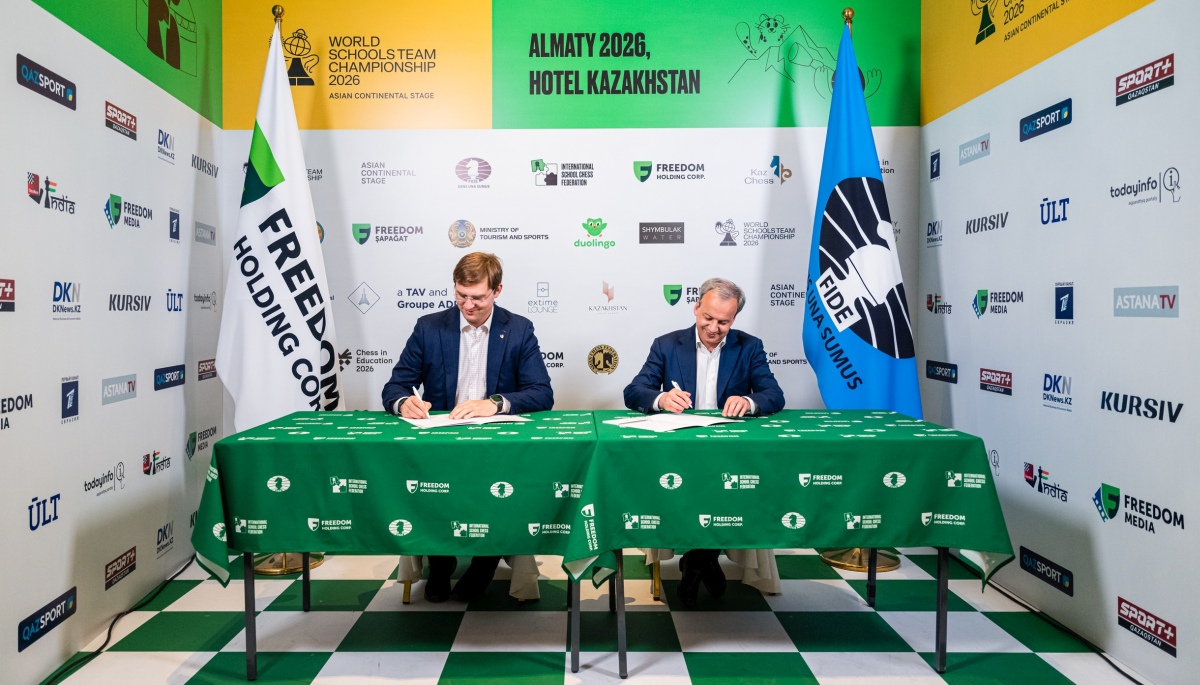
The International Chess Federation (FIDE) and the investment company Freedom Holding Corp have signed a Memorandum on cooperation focused on global promotion, development, and accessibility of chess. Freedom Holding Corp will serve as an official Partner of FIDE in chess development programmes in 2026. The cooperation covers four areas and includes: a) Organisation and sponsorship of international, continental, and regional chess tournaments b) Provision of financial and material support to players, coaches, and training centres across all continents c) Implementation of chess educational programmes with financial support d) Talent scouting programmes and initiatives through financial support The agreement covers the period from April 6 to December 31, 2026, with both parties viewing it as the first step in a broader long term cooperation.. Both FIDE and Freedom Holding Corp have committed to working in good faith for the benefit of chess development worldwide. Lorem ipsum dolor sit amet, consectetur adipiscing elit. Ut elit tellus, luctus nec ullamcorper mattis, pulvinar dapibus leo. Freedom Holding Corp has already contributed significant financial support for elite and school chess in recent years, recognising the importance of chess in education, cognitive development, and cultural exchange. As the official Partner, Freedom Holding will support FIDE’s ongoing initiatives and strategic goals to broaden the reach of chess, building a greater, stronger, and more inclusive chess community. “Freedom Holding Corp and its CEO, Mr. Timur Turlov, have been strong supporters of chess in recent years, recognising the value and high potential of the sport. In a year when FIDE is staging many of our most important events, we are strengthening our existing bond and laying a foundation for a better and more prosperous global chess community,” FIDE President Arkady Dvorkovich said. More details on the projects and the funding will be released in due course.
School chess unites continents: Winners crowned at Asian Continental Stage of World Schools Team Championship 2026
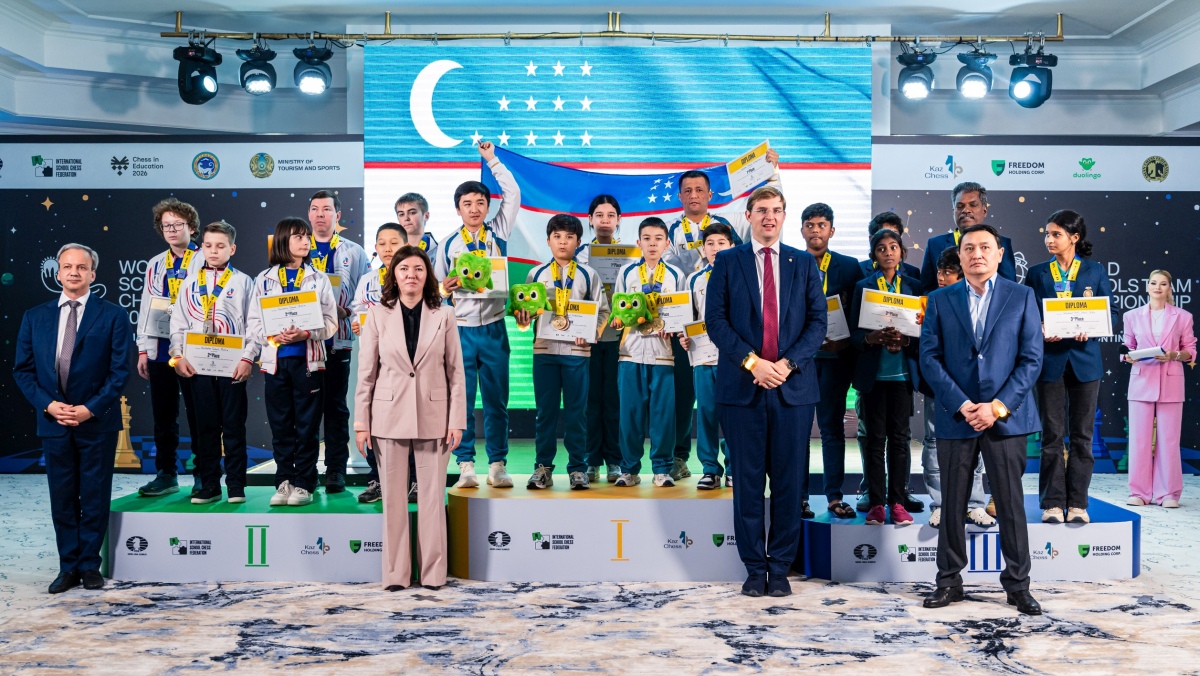
The Asian Continental Stage of the World Schools Team Championship 2026 concluded in Almaty, Kazakhstan, with Wisdom School (Tashkent, Uzbekistan) claiming victory and securing a berth in the Grand Final scheduled for December 2026. The top Kazakh team, SEED Uniker School (Astana), finished fourth. Organised by the International Chess Federation (FIDE), the International School Chess Federation (ISCF), the Kazakhstan Chess Federation, the Ministry of Tourism and Sports of the Republic of Kazakhstan, and the Akimat of Almaty – with Freedom Holding Corp as General Partner – the tournament took place from April 7-10, 2026 at the Kazakhstan Hotel. It brought together 114 young players aged 8 to 14 from 19 countries, competing in an 8-round Swiss system with a time control of 45 minutes plus a 10-second increment. The entire event embraced a space theme in honour of Cosmonautics Day on 12 April. On the final day, FIDE President Arkady Dvorkovich and Kazakh cosmonaut and National Hero of Kazakhstan Aydyn Aimbetov made the ceremonial first move – a symbolic gesture highlighting the shared values of chess and space exploration: strategic thinking, teamwork, and the pursuit of new horizons. “This tournament has become a true example of the promising future of chess on our continent and the potential of educational systems. We all understand and value the importance of education, especially at the school level. In FIDE, 2026 has been declared the Year of Chess in Education, and school team championships hold a special place among the key events of this initiative. This year, numerous conferences, seminars, and tournaments are taking place, all dedicated to promoting the positive role of chess in early development,” said FIDE President Arkady Dvorkovich. Final standings (average rating in parentheses): Wisdom School (Tashkent, Uzbekistan) (2024) – 16 match points Kurchatov School (Moscow, Russia) (2275) – 14 Velammal MHS School (Chennai, India) (1908) – 12 SEED Uniker School (Astana) (2023) – 10 (EMGSB – 141) Bashu Secondary School (Chongqing, China) (1722) – 10 (132) RFMSH (Almaty) (1676) – 10 (116) Maliyadeva College (Kurunegala, Sri Lanka) (1602) – 10 (95) Bolovsrol Secondary School (Ulaanbaatar, Mongolia) (1616) – 9 ACG Sunderland (Auckland, New Zealand) (1834) – 8 (157) Lyceum School No. 173 (Almaty) (1818) – 8 (143) In case of a tie, Extended Direct Encounter (EDE) was applied first, followed by EMGSB (Extended Sonneborn-Berger). In addition to team awards, gold, silver, and bronze medals were awarded to the best players on each board (based on performance percentage). Among them were two Kazakhstani juniors. Organised by the International Chess Federation (FIDE), the International School Chess Federation (ISCF), the Kazakhstan Chess Federation, the Ministry of Tourism and Sports of the Republic of Kazakhstan, and the Akimat of Almaty – with Freedom Holding Corp as General Partner – the tournament took place from April 7-10, 2026 at the Kazakhstan Hotel. It brought together 114 young players aged 8 to 14 from 19 countries, competing in an 8-round Swiss system with a time control of 45 minutes plus a 10-second increment. The entire event embraced a space theme in honour of Cosmonautics Day on 12 April. On the final day, FIDE President Arkady Dvorkovich and Kazakh cosmonaut and National Hero of Kazakhstan Aydyn Aimbetov made the ceremonial first move – a symbolic gesture highlighting the shared values of chess and space exploration: strategic thinking, teamwork, and the pursuit of new horizons. The closing ceremony on 10 April at the Kazakhstan Hotel featured distinguished guests including FIDE President Arkady Dvorkovich, Minister of Education of the Republic of Kazakhstan Zhuldyz Suleimenova, Deputy Akim of Almaty Nurlan Abdrakhim, and President of the International School Chess Federation and the Kazakhstan Chess Federation Timur Turlov. The closing ceremony on 10 April at the Kazakhstan Hotel featured distinguished guests including FIDE President Arkady Dvorkovich, Minister of Education of the Republic of Kazakhstan Zhuldyz Suleimenova, Deputy Akim of Almaty Nurlan Abdrakhim, and President of the International School Chess Federation and the Kazakhstan Chess Federation Timur Turlov. “The Head of State, Kassym-Jomart Tokayev, has identified the formation of an intellectual nation as one of the country’s key strategic priorities. Today’s tournament clearly demonstrates the consistent implementation of this policy. Chess has firmly entered both the academic curriculum and extracurricular activities, becoming an important part of the modern school environment. It develops strategic and logical thinking and strengthens discipline among young people,” said Minister Zhuldyz Suleimenova. She also noted the successful implementation of the “Chess in Education” program in partnership with the Kazakhstan Chess Federation. The ceremony included a performance by Junior Eurovision participant Karakat Bashanova. During her song, the lights were turned off, and the audience raised LED bracelets, creating a sky of hundreds of glowing “stars.” Organizers emphasized: “If stars are lit, it means someone needs them,” symbolizing that every child present is a future star. The event culminated in a symbolic handover to Africa – the next continental stage – marked by a countdown and hundreds of paper airplanes launched by the audience. “Kazakhstan is building open and friendly connections with the world,” said Timur Turlov. “I hope our tournament has contributed to this process. We are very glad that our international guests experienced genuine Kazakh hospitality and discovered Almaty. I believe the connections formed here will stay with these young players for years to come.” The closing ceremony on 10 April at the Kazakhstan Hotel featured distinguished guests including FIDE President Arkady Dvorkovich, Minister of Education of the Republic of Kazakhstan Zhuldyz Suleimenova, Deputy Akim of Almaty Nurlan Abdrakhim, and President of the International School Chess Federation and the Kazakhstan Chess Federation Timur Turlov. “The Head of State, Kassym-Jomart Tokayev, has identified the formation of an intellectual nation as one of the country’s key strategic priorities. Today’s tournament clearly demonstrates the consistent implementation of this policy. Chess has firmly entered both the academic curriculum and extracurricular activities, becoming an important part of the modern school environment. It develops strategic and logical thinking and strengthens discipline among young people,” said Minister Zhuldyz Suleimenova. She also noted the successful implementation of the “Chess in Education” program in partnership with the Kazakhstan Chess Federation. Two memorandums were also signed
Asia Makes Its Move: Asian Stage of the World Schools Team Championship 2026 Kicks Off in Almaty
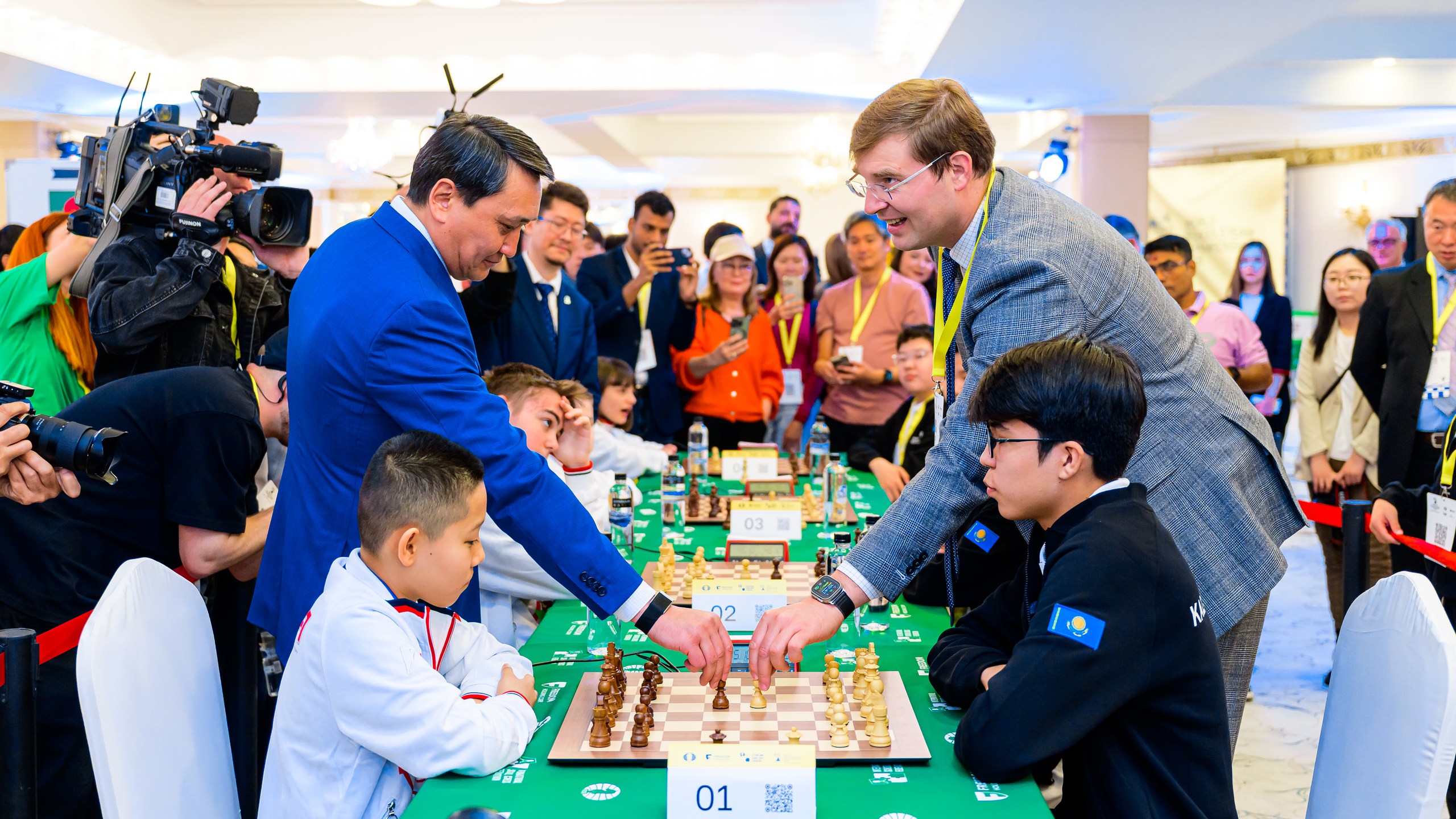
Press ReleaseAsia Makes Its Move: Asian Stage of the World Schools Team Championship 2026 Kicks Off in Almaty From April 7 to 10, 2026, Almaty hosts Asia’s premier school chess event. The Asian Continental Stage of the World Schools Team Championship 2026 has officially begun — the first tournament of its kind, organized by FIDE and the International School Chess Federation (ISCF) with the support of генерального партнёра Freedom Holding Corp. This marks the launch of a new global cycle. Four continents will host their own stages, with winners earning direct qualification to the Grand Final in December 2026. There, the strongest school teams in the world will compete for the world championship title. The Asian stage opens the cycle and sets the tone for the season. The year 2026 has been declared by FIDE and ISCF as the Year of Chess in Education — a global initiative highlighting the role of chess in developing critical thinking, strategy, concentration, memory, discipline, and teamwork. President of the International Chess Federation (FIDE) Arkady Dvorkovich addressed participants in a video message: “Our goal is simple: we want to integrate chess into school systems around the world. We engage with governments, collaborate with international organizations, and organize school tournaments and conferences to demonstrate that chess is not just a game, but a powerful educational tool. The competition is not just a tournament stage — it also includes educational workshops and masterclasses. I hope you take full advantage of these opportunities.” At the same time, Arkady Dvorkovich is in Cyprus attending one of the most prestigious events in the global chess calendar — the Candidates Tournament 2026, where the world’s top players compete for the right to challenge the World Champion. Among them is Bibisara Assaubayeva. Meanwhile, in Almaty, Timur Turlov opened the Asian Stage of the World Schools Team Championship — a tournament where future stars of world chess are born. Symbolically, the event takes place on the eve of Cosmonautics Day (April 12). The theme is truly “cosmic”: young players from different countries are making their first strategic moves that, like space exploration, open new horizons of thinking, teamwork, and intellectual growth. Chess teaches you to think several moves ahead — just as dreams of space inspire generations to achieve breakthroughs. The organizers of the Asian stage include the International Chess Federation (FIDE), the Ministry of Tourism and Sports of the Republic of Kazakhstan, the Akimat of Almaty, the International School Chess Federation (ISCF), and the Kazakhstan Chess Federation led by its President Timur Turlov. He noted: “Kazakhstan is not opening the global season of school chess by chance. Over the past three years, we have built a system that has turned chess into a полноценный element of the national educational environment — with its own methodology, trained teachers, and a strong regional network. The pace of development of school chess here is among the fastest in the region. With the support of the President, we have not only launched the initiative but expanded it nationwide. Today, more than 60,000 children are systematically engaged in chess in schools, and this number continues to grow. We see real interest from students and parents, which confirms strong social demand and long-term potential. It is therefore natural that the Asian Stage of the World Schools Team Championship is held in Almaty.” The organizers of the Asian stage include the International Chess Federation (FIDE), the Ministry of Tourism and Sports of the Republic of Kazakhstan, the Akimat of Almaty, the International School Chess Federation (ISCF), and the Kazakhstan Chess Federation led by its President Timur Turlov. He noted: “Kazakhstan is not opening the global season of school chess by chance. Over the past three years, we have built a system that has turned chess into a full-fledged element of the national educational environment — with its own methodology, trained teachers, and a strong regional network. The pace of development of school chess here is among the fastest in the region. With the support of the President, we have not only launched the initiative but expanded it nationwide. Today, more than 60,000 children are systematically engaged in chess in schools, and this number continues to grow. We see real interest from students and parents, which confirms strong social demand and long-term potential. It is therefore natural that the Asian Stage of the World Schools Team Championship is held in Almaty.” The official opening ceremony took place today, followed by the first two rounds of play. The tournament consists of eight rounds played under the Swiss system, with two rounds per day. The time control is 45+10 (45 minutes per game with a 10-second increment per move starting from move one). Teams earn 2 points for a win and 1 point for a draw. A total of 26 school teams from 19 countries are participating, including Australia, India, China, New Zealand, Singapore, Malaysia, and countries from Central and South Asia, among others. All participants are students aged 8–14. Teams represent general education schools only — chess academies, specialized clubs, and mixed teams are not allowed. Each team consists of four main players and one reserve. The tournament features some of the strongest school teams, including prize-winners of previous world competitions, ensuring a highly competitive field. In addition to the main competition, organizers have prepared an extensive side program. Children will take part in interactive workshops and entertainment activities, while parents and local chess enthusiasts can attend masterclasses led by leading coaches and grandmasters. Dedicated educational sessions are also organized for teachers and parents, reinforcing the tournament’s educational mission. A special highlight is a social initiative in partnership with Duolingo India: ISCF has granted a Wild Card to a girls’ team from underprivileged communities, for whom this tournament represents a meaningful step beyond their usual environment. The program also includes exhibition matches and interactive experiences such as Quantum Chess. On April 9, a joint event with QJ League and Footlab will take place, featuring a tour of a football